
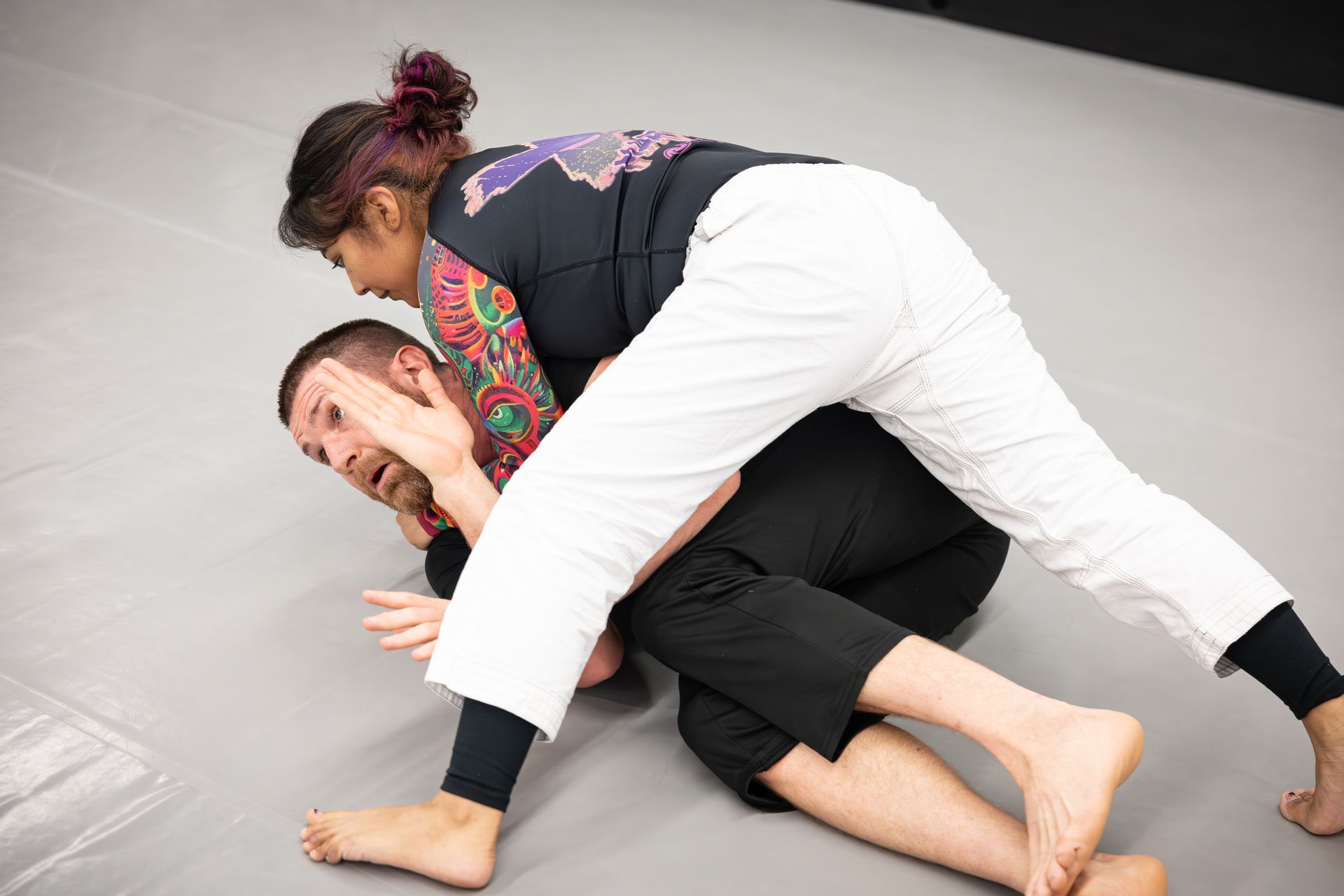
Learn a handful of fundamentals well, and your first months on the mats start feeling a lot less overwhelming.
Starting Brazilian Jiu Jitsu can feel like drinking from a firehose. There are new words, new positions, and a whole new way of thinking about movement and pressure. In our beginner classes, we keep coming back to one simple idea: if you can survive, you can learn. That means you need a small set of reliable techniques you can actually hit when you’re tired, sweaty, and thinking a little slower than usual.
We also see something encouraging all the time: you do not need to be big or “naturally athletic” to make progress in Brazilian Jiu Jitsu. The art was built around leverage, timing, and structure. Once you understand a few core positions and escapes, you stop feeling stuck and start noticing patterns. That’s when training gets fun.
Below are five essentials we coach consistently in our Adult Jiu-Jitsu in Hamden program because they show up every single round. Mastering them gives you a foundation you can build on for years, whether your goal is fitness, self-defense, competition, or simply learning something challenging that clears your head after work.
What makes a technique “beginner essential” in Brazilian Jiu Jitsu?
A beginner technique is not “easy.” It’s repeatable under pressure, teaches you the right habits, and connects to other skills like a good set of building blocks. We look for moves that help you do at least one of these things:
• Stay safe when you’re in a bad spot
• Control posture and distance so you can breathe and think
• Improve position before you chase submissions
• Work in both gi and no-gi without needing advanced grip knowledge
• Scale up as you gain experience, instead of becoming obsolete later
You’ll notice that list is not flashy. That’s on purpose. When you’re new to Brazilian Jiu Jitsu in Hamden, the fastest path forward is usually the fundamentals done with care, not a highlight-reel technique done once.
1) Closed Guard: your home base from the bottom
Why closed guard matters
Closed guard is one of the first positions we teach because it gives you a way to slow things down when you’re on your back. Your legs wrap around your partner’s waist, which limits movement and helps you manage distance. For beginners, it’s a relief: you’re not simply stuck underneath someone, you’re connected on your terms.
Closed guard also teaches core concepts that show up everywhere in Brazilian Jiu Jitsu: posture control, breaking balance, and using your hips instead of just your arms. If you learn to keep your guard closed, you’ll survive longer. If you learn to attack from it, you’ll start dictating the round.
Key details we coach
We cue a few priorities that make closed guard work reliably:
1. Break posture first by controlling the head, collar, or wrist line depending on gi or no-gi
2. Keep your hips active by angling slightly, not lying flat like a board
3. Use your legs as clamps and steering wheels, not just hooks you forget about
4. Stay patient, because rushing usually opens your guard for free
A lot of beginners squeeze with their knees and burn their legs out in 20 seconds. We’d rather you learn to connect, off-balance, and breathe. Closed guard is a “long game” position, and that’s exactly why it’s so valuable early.
2) Toreando Guard Pass: a simple way to get around the legs
What the toreando teaches
Passing the guard can feel like trying to walk through a revolving door. The toreando pass (sometimes called the bullfighter pass) gives you a clear concept: move the legs away, step around, and claim space before your partner recovers.
Even if you don’t finish the pass perfectly at first, the toreando teaches footwork, grips, timing, and the idea of circling to the side instead of driving straight forward. It’s also a great gateway into more advanced passing later, but it works as a beginner option because the goal is straightforward.
Common mistakes and fixes
Most issues we see are easy to clean up with the right focus:
- Mistake: leaning forward and getting pulled into guard again
Fix: keep your posture tall and your head over your hips
- Mistake: stepping too close and getting hooked
Fix: control the shin line and keep your steps wide enough to avoid sticky hooks
- Mistake: passing but never settling
Fix: finish by connecting chest-to-chest or chest-to-shoulder and winning the crossface or head control
In our Adult Jiu-Jitsu in Hamden classes, we like toreando because you can feel immediately when it works. Your partner’s legs stop being a wall, and suddenly side control is there.
3) The Shrimp (Hip Escape): the movement that saves you everywhere
Why we obsess over this movement
If we could give beginners one “superpower,” it would be the hip escape, commonly called the shrimp. It shows up in side control escapes, mount escapes, guard recovery, and even scrambles. It’s not glamorous, but it is the movement that lets you create space without trying to bench press someone off you.
Shrimping teaches you to move your hips away while keeping frames in place. It’s the difference between feeling crushed and feeling like you have options. And yes, it’s tiring at first. That’s normal. Over time, it becomes smooth, almost automatic.
A practical shrimping checklist
When you’re drilling, we encourage you to hit these points:
• Frame first with your forearms and elbows, not your hands pushing randomly
• Turn slightly onto your side so your hips can actually move
• Slide your hips away, then bring your knee back inside to re-guard
• Repeat in small steps rather than trying one huge explosive escape
• Keep your chin tucked and your breathing steady, especially under pressure
This is one of the fastest ways to level up your Brazilian Jiu Jitsu experience because it turns “I’m stuck” into “I can build a guard again.”
4) Bridge and Roll (Upa) Escape from Mount: your first high-percentage survival tool
The scenario you will face early
Mount is a rough place for beginners. It’s heavy, it’s frustrating, and it can make you feel like your lungs have shrunk. The bridge and roll escape gives you a direct answer: trap an arm, trap a foot, bridge, and turn the corner.
We like this escape because it teaches structured problem-solving. You’re not flailing. You’re isolating posts and using your hips, which are stronger than your arms. And once you understand the mechanics, you can adapt it whether you train gi or no-gi.
What makes it work
The bridge and roll is about timing and traps, not raw power:
1. Protect your neck and keep elbows tight so your partner can’t climb higher
2. Trap the arm on one side so your partner cannot post
3. Trap the same-side foot so the base is removed
4. Bridge up and slightly toward the trapped side, then roll
5. Land in top position and immediately stabilize, because the job isn’t finished yet
We also coach beginners to avoid bridging straight up like a deadlift. The direction matters. When you angle the bridge, you turn their balance into a problem they can’t easily solve.
5) Triangle Choke from Guard: a beginner submission that rewards good position
Why the triangle belongs on a beginner list
We usually teach beginners to prioritize escapes and control before submissions, but the triangle choke earns its place because it’s built on fundamentals. It’s not just “throw your legs up.” A clean triangle teaches posture breaking, angle creation, leg positioning, and patience.
It’s also a technique that scales with you. Early on, you might only hit it when your partner makes a big mistake. Later, you’ll learn to set it up from collar ties, wrist control, and even transitions from failed sweeps. That makes it one of the best “first submissions” in Brazilian Jiu Jitsu.
The details that make it click
The triangle is usually won by angles, not by squeezing harder:
• Break posture and get your opponent’s arm across your centerline
• Shoot your leg high over the shoulder and clamp your knee line
• Cut the angle by scooting your hips out, so you’re not square underneath
• Lock the figure-four with your legs and keep your knees pinched
• Finish with controlled pressure, not a frantic yank on the head
We also emphasize tapping early and applying chokes gradually. Beginners improve fastest when training stays safe and consistent, week after week.
How we suggest practicing these five techniques in your first month
Learning techniques is one thing. Making them show up in live rounds is another. We help you bridge that gap by giving you a simple structure so you’re not trying to remember twenty ideas at once.
Here’s a beginner-friendly way to focus, especially if you’re new to Brazilian Jiu Jitsu in Hamden and you want progress you can actually feel:
1. Week 1: Escape focus
Drill shrimping and the bridge and roll, then try to use them once per round.
2. Week 2: Guard focus
Start rounds in closed guard and work on posture control before you attack.
3. Week 3: Passing focus
Practice toreando footwork with light resistance and learn to settle side control.
4. Week 4: Add one submission
Work triangle setups from closed guard, but only after you break posture and create an angle.
If you miss a week because life gets busy, it’s fine. Come back and pick up the thread. Consistency beats intensity in the long run, and your body will thank you for building gradually.
Quick beginner reminders we repeat every class
A lot of early success in Adult Jiu-Jitsu in Hamden comes down to small habits. You can absolutely learn faster by keeping these in mind:
• Tap early and tap clearly, especially when you’re caught and unsure
• Breathe on purpose; holding your breath is a fast track to fatigue
• Use frames and hips first, then hands and arms
• Win position before submissions, because control makes everything easier
• Ask questions after rounds; we want you to understand what happened
These habits sound simple, but they’re the difference between feeling lost and feeling like you’re building a real skill set.
Take the Next Step with Soulcraft Martial Arts
If you focus on closed guard, toreando passing, shrimping, the bridge and roll, and a clean triangle, you’ll cover a surprising amount of what happens in real training. Those five techniques give you a base for control, survival, and your first dependable attacks, without rushing into advanced moves that don’t serve you yet.
We teach these fundamentals every week at Soulcraft Martial Arts, and we build them into a progression that makes sense for beginners training Brazilian Jiu Jitsu in Hamden. If you’re ready to start, we’ll help you train safely, understand what you’re doing, and enjoy the process as your confidence grows.
New to Brazilian Jiu Jitsu? Try a free class and see how welcoming and beginner friendly training can be.