
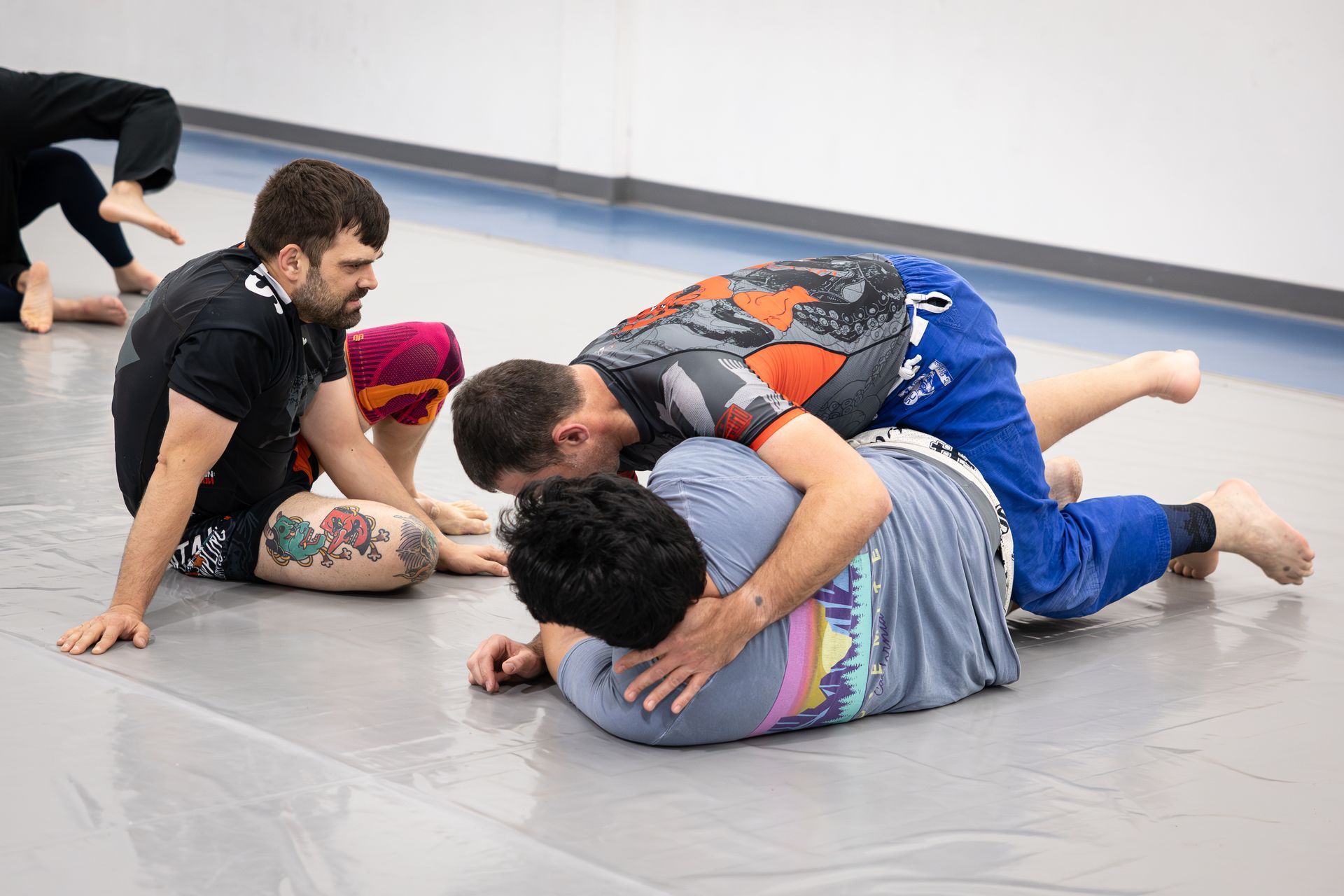
Adult Jiu-Jitsu can feel like a workout for your body and your attention at the same time.
If you have ever wanted a fitness routine that stays interesting, Adult Jiu-Jitsu is hard to beat. You are not just counting reps or zoning out on a machine. You are learning a skill while you move, breathe, and adapt in real time, which is a big reason many adults in Hamden keep showing up once they get started.
In our adult program, we treat Brazilian Jiu-Jitsu as a practical, adaptable practice. You learn how to control positions, solve problems under pressure, and build a body that moves well close to the floor. And because life is busy, we also pay attention to the parts that make training sustainable: how class is structured, what beginners should expect, and how we reduce risk so you can train for the long haul.
Below, we break down how Adult Jiu-Jitsu in Hamden can enhance focus, develop functional strength, and support mobility, with clear guidance on what you will actually do in class and how to start safely.
Why Adult Jiu-Jitsu works for busy adults in Hamden
A lot of adults around Hamden are juggling full schedules: commuting, family logistics, long workdays, or school commitments. The most helpful thing about Adult Jiu-Jitsu is that it packs multiple training goals into one session. You are building conditioning, coordination, and confidence while learning a real skill.
Unlike exercise that is purely repetitive, Brazilian Jiu-Jitsu gives you a clear path of progress. One week you are learning a basic hip escape. A few weeks later, you are using it to recover guard. Later, you are connecting it to sweeps and stand-ups. That sense of progression matters, especially when motivation dips or you have a stressful week.
We also keep the experience adult-friendly. Modern Adult Jiu-Jitsu in Hamden is not just for competitors or people who already feel athletic. Technique, leverage, posture, and timing matter more than raw speed, and that makes training approachable at many ages and fitness levels.
Focus: training your attention under pressure
Adult life pulls your attention in a dozen directions. Jiu-Jitsu flips that. You cannot scroll, multitask, or half-listen when someone is trying to pass your guard. You have to notice details: your posture, grips, breathing, balance, distance, and what your partner is setting up.
The “mental reps” happen constantly
Every round creates small decision points. You recognize a position, pick a response, adjust, and try again when it does not work. That loop is basically problem-solving practice, repeated over and over with immediate feedback.
A 2024 review that looked at 72 studies on martial arts found the most consistent cognitive findings involved perception and inhibitory control, meaning the ability to regulate an impulsive response. In plain language, that is the skill of pausing, reading what is happening, and choosing a smarter action instead of panicking. We describe this as a likely training benefit, not a guaranteed outcome for everyone, and it is not a substitute for mental-health care. But many adults do tell us that the habit of staying calm and thinking clearly carries over into work and home life.
Breathing and composure are part of the curriculum
We coach you to breathe and slow down, especially in uncomfortable positions. That sounds simple, but it is a real skill. When you learn to keep your breathing steady while solving a physical problem, you are practicing composure in a very honest environment. You cannot fake it, and you do not have to be perfect either. You just keep improving.
Strength: building useful power without chasing numbers
Adult Jiu-Jitsu builds functional strength because you are moving your body and managing another person’s resistance. That includes pushing, pulling, gripping, bracing, bridging, standing, sprawling, and controlled ground movement. It is strength that shows up in posture, balance, and the ability to keep working when you are tired.
Research on BJJ performance has linked strength, grip capacity, and endurance with success in the sport. We do not promise specific calorie burn or body-composition changes because that depends on your training frequency, nutrition, sleep, and a lot of personal variables. What we can say is that the training stimulus is real, and it tends to build a broad base of usable strength.
Where you will feel it first
Most adults notice a few areas getting stronger quickly, mostly because BJJ asks them to work in ranges and positions that daily life does not.
• Grip and forearm endurance from controlling sleeves, collars, wrists, and frames
• Core stability from bracing during passing, guard work, and transitions
• Hip and leg strength from bridging, standing up safely, and maintaining base
• Shoulder and upper-back strength from posture, pulling, and pressure control
• Full-body coordination from linking movements together under resistance
You will also experience interval-style conditioning: bursts of effort with short recovery periods. That is why a single class can feel like you trained your whole body, even if the techniques were relatively simple.
Mobility: moving well on the floor and getting back up confidently
Mobility is not just flexibility. For most adults, it is the ability to control your body through useful ranges of motion, especially when you are changing levels, rotating your hips, or supporting weight through your shoulders and trunk.
Brazilian Jiu-Jitsu in Hamden is especially good at making people comfortable closer to the ground. Many adults do not spend much time getting up and down, rolling, or using their hips actively. BJJ brings that back in a structured way.
Foundational movements that build “real-world” mobility
In our beginner-friendly approach, we teach movements progressively, with coaching on mechanics and pacing. Common building blocks include:
1. Bridging to move your hips and create space
2. Hip escapes to recover guard and reduce pressure
3. Technical stand-ups to get up while protecting your balance
4. Guard movement to coordinate hips, frames, and timing
5. Controlled level changes for takedown entries and base
The evidence around martial arts and mobility, especially in older adults, is promising but often low certainty and not always specific to BJJ. So we keep claims realistic: Adult Jiu-Jitsu in Hamden may help you improve body awareness, active range of motion, and confidence moving on the floor, especially when you train consistently and do the movements with good form.
What a first Adult Jiu-Jitsu class looks like here
Most beginners worry about two things: getting hurt and feeling lost. We design the first few weeks to reduce both.
A typical class flow is straightforward and repeatable, which helps you relax and learn.
Class structure you can expect
- Warm-up focused on grappling movement, joint prep, and getting your body ready to work
- Technique instruction where we break down positions step by step and answer questions as we go
- Partner drilling with coaching so you can feel the details, not just memorize steps
- Optional positional rounds where you start from a specific situation and practice with control
- Cooldown and quick review so you leave with a clear takeaway, not a blur of moves
If you are brand new, we keep the early emphasis on fundamentals, safety, and good habits. You do not need to “win” anything in your first class. You just need to learn how to move and communicate.
What to wear and how to arrive
For a first class, comfortable athletic clothing without zippers, buttons, or anything hard is usually the easiest choice. If you are unsure about uniform details, the website is the best place to confirm what we require and what we can provide.
Try to arrive a bit early so we can orient you, answer questions, and pair you appropriately. That small buffer makes the whole experience feel calmer.
Safety and injury prevention: how we keep training sustainable
Jiu-Jitsu is a contact sport, and contact comes with risk. The goal is not to pretend risk does not exist. The goal is to manage it intelligently through coaching, culture, and controlled training.
A 2025 global study of 881 BJJ practitioners reported an injury incidence of 5.5 injuries per 1,000 training hours and 55.9 per 1,000 matches. Many injuries occurred during training, particularly sparring, with knees and shoulders among the most commonly affected areas. That aligns with what responsible academies already prioritize: learn the fundamentals first, roll with control, and match partners thoughtfully.
Practical habits that reduce risk
We coach these principles from day one:
• Tap early, and treat your partner’s tap as immediate and non-negotiable
• Focus on clean technique before intensity, especially on escapes and submissions
• Avoid forcing submissions or using explosive movement when you are out of position
• Warm up with intention before harder rounds, not as an afterthought
• Tell us about injuries and limitations so we can adjust drilling and pairings
• Increase training frequency gradually so joints and connective tissue can adapt
If pain is persistent, sharp, or worsening, getting medical advice is the right move. We can modify training, but we cannot diagnose or treat injuries. We also do not expect you to “fight through” pain to prove toughness. That mindset shortens training careers.
Who Adult Jiu-Jitsu in Hamden is for (and how we adapt it)
Adults start for different reasons: fitness, skill-building, stress relief, self-defense interest, or simply wanting a community that gets them out of the usual routine. Our job is to meet you where you are and help you build a sustainable practice.
Beginners with no athletic background
You do not need to be in shape before starting. You get in shape by training. We keep early training focused on fundamentals, pacing, and learning to move efficiently.
Professionals who want a structured outlet
Training gives you a clear hour where your attention is fully engaged. Many people find that helpful for stress management, but we stay honest about the limits: BJJ can support mood and daily stress for some students, but it is not a replacement for professional mental-health care.
Adults with past injuries or limitations
Bad knee, shoulder history, stiff lower back, or wrist issues are common. If you tell us what is going on, we can usually adjust positions, modify intensity, and help you choose safer training partners. The key is communication and patience.
Older adults and non-competitors
Competition is optional. Adult Jiu-Jitsu can be practiced as a lifelong skill, and we keep training technique-first so you can progress without relying on speed or brute strength.
Training frequency: a realistic plan that actually fits your life
Consistency matters more than heroic effort. For many adults, two classes per week is a strong starting point. It is frequent enough to build skill and conditioning, but not so much that your schedule collapses.
From there, you can add sessions based on recovery and goals. Some weeks you will feel great and want more. Other weeks you might scale back. That is normal. The long-term win is staying in the game.
If you want extra strength or muscle gain, you can add a simple strength program, but you do not need to lift to get value from training. BJJ itself builds a lot of resilience and full-body capacity.
Take the Next Step with Soulcraft Martial Arts
Building focus, strength, and mobility is not about finding a perfect workout. It is about finding a practice you can stick with, one that keeps teaching you something new. Adult Jiu-Jitsu does that well, and it does it in a way that feels practical the moment you step on the mats.
When you are ready to try Brazilian Jiu-Jitsu in Hamden, our team at Soulcraft Martial Arts will guide you through a structured, beginner-friendly experience that emphasizes safety, fundamentals, and steady progress, so you can train with confidence.
Build strength, discipline, and confidence through martial arts training at Soulcraft Martial Arts.