
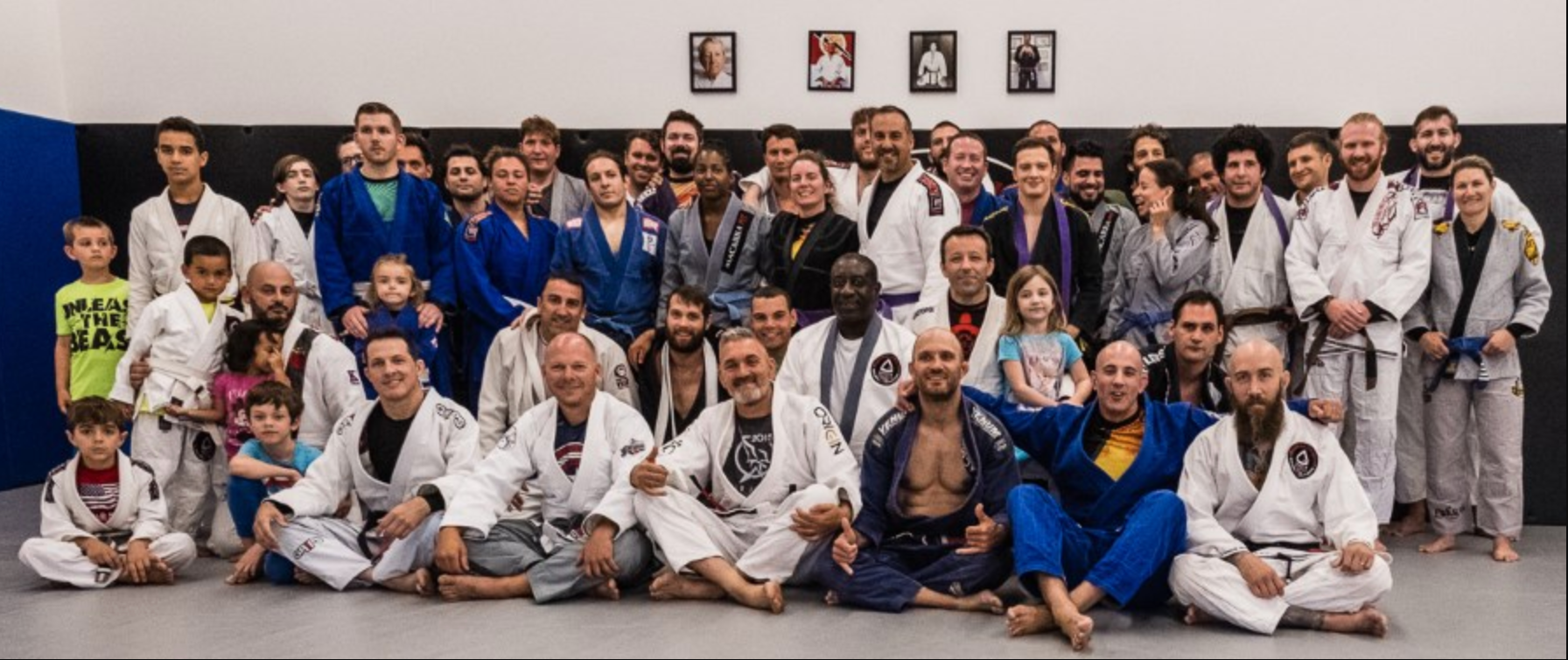
Brazilian Jiu Jitsu is one of the rare workouts where you can walk in as a stranger and leave with training partners who actually know your name.
Community is a word that gets tossed around a lot in fitness, but Brazilian Jiu Jitsu has a built-in advantage: you cannot do it alone. From the first class, you are learning with a partner, checking in, adjusting grips, laughing at awkward footwork, and slowly building trust through repetition. That partner-based structure is exactly why so many adults in Hamden stick with training long after the initial “try something new” phase wears off.
We also see something else happen that is easy to miss until you experience it: friendship forms in the quiet moments between rounds. The quick nod after a tough roll, the “good catch” when someone learns to escape, the shared relief when you remember to breathe. In a world full of solo treadmills and earbuds, Brazilian Jiu Jitsu in Hamden gives you real human connection, one round at a time.
Why partner training turns strangers into friends faster than most hobbies
Most social activities let you stay on the surface. In Jiu-Jitsu, you learn each other’s habits quickly, because you have to. When you drill a technique, you are cooperating. When you spar, you are testing each other, but still cooperating, because you are both responsible for training safely and improving together.
That combination of teamwork and honest feedback creates a kind of shortcut to connection. You do not have to force small talk. The class itself gives you a shared language: frames, posture, pressure, timing. Even if you are not naturally chatty, you still end up communicating because your partner needs clear cues to learn.
There is also a steady rhythm to it. You might see the same people two or three times a week, which matters. Consistency is a friendship engine. And for many adults balancing work, parenting, and long days, Adult Jiu-Jitsu in Hamden becomes the one appointment that is not negotiable, because it is both stress relief and social time.
The trust factor: why “rolling” builds real bonds
If you are new, sparring can sound intimidating. In practice, controlled rolling is where people start to genuinely look out for each other. You learn to protect your partner’s joints, you learn to tap early, and you learn to match intensity so the round stays productive instead of chaotic.
That care adds up. Trust in Brazilian Jiu Jitsu is not an abstract idea. It is practical: your partner releases a submission when you tap, and you do the same. You both leave class able to come back tomorrow. Over time, that repeated experience makes the room feel safe, even when the training is challenging.
Nationally, many practitioners report noticeable mental benefits quickly, including improved confidence and reduced anxiety. When people feel calmer and more capable, classes run smoother. Communication improves. Egos soften. The group gets stronger together, not just physically, but socially.
What community looks like on a normal night in Hamden
A typical evening has a few familiar patterns. People trickle in from different routines, some straight from work, some from putting kids to bed, some from a day that probably felt too long. Shoes come off, people say hello, and there is that small shift in the air where the outside noise drops.
Warm-ups happen together, and that matters more than it seems. Moving in sync, even doing something simple, helps you feel like you belong. Then technique starts, and partners rotate. You get exposed to different body types, different speeds, different personalities, and you learn how to work with all of it. That is not just a grappling skill, it is a social skill.
By the time rounds begin, the room is humming. You might not “win” every exchange, but you will almost always win something: a cleaner escape, better balance, one moment of patience instead of panic. And those wins get noticed. When someone says, “That was a nice adjustment,” it lands, because it came from someone who felt the difference firsthand.
Brazilian Jiu Jitsu as a social skill, not just a martial art
One of the underrated outcomes of consistent training is that you get better at being around people, even if you are tired, even if you are stressed, even if you would normally isolate. You practice showing up anyway, communicating, and staying respectful under pressure. That translates directly into daily life.
We often see adults become more comfortable with healthy boundaries. In Jiu-Jitsu, boundaries are clear: tapping, pausing, resetting, asking questions. You get used to speaking up, but without drama. You also learn to receive feedback without taking it personally, because everyone is trying to solve the same puzzle.
If you have been looking for a way to build friendships without forcing it, Brazilian Jiu Jitsu in Hamden is surprisingly effective. The friendships are not based on perfect first impressions. They are based on shared effort and mutual support, which lasts longer.
The beginner experience: how we help you plug into the room quickly
Starting something new as an adult can feel awkward. We get that, and we structure classes so you are not left guessing. You learn the basics in a way that protects your body and your confidence at the same time: positioning, escapes, and the idea that tapping is normal and smart.
For community, the biggest beginner hurdle is feeling like you are “behind.” The truth is that everyone remembers being new, because in Jiu-Jitsu, the learning curve is real. That shared memory creates patience in the room. We also intentionally pair people in ways that help you learn instead of just survive.
Here are a few things that make your first month feel more human and less overwhelming:
• We focus on simple, repeatable fundamentals so you can recognize patterns quickly, even if you only train a couple times per week.
• We encourage questions during drilling, because clear communication is part of safety and part of learning.
• We keep the room structured so you always know what to do next, which helps when you are tired or nervous.
• We reinforce tapping early and often, because staying healthy is what keeps you training and connected.
• We build a culture where improvement gets noticed, not just athleticism, so you feel included even before you feel “good.”
If you train two or more times per week, many people notice mood and stress improvements within a few weeks, and the social comfort tends to follow soon after. By months two and three, it is common to feel like you have a few go-to training partners and a real routine.
Friendship through shared milestones: stripes, belts, and small wins
You do not need to compete to feel progression in Brazilian Jiu Jitsu. In fact, plenty of practitioners never compete and still develop strong ties through consistent training. The milestones that matter most are often quiet: your first clean guard retention, your first escape that works on someone better, your first round where you do not hold your breath the whole time.
Belt progression also creates long-term community. People are not just showing up for a six-week challenge. White belt alone often lasts a couple of years, which means you grow alongside the same faces. That time is what turns friendly classmates into actual friends.
And because there are always different experience levels on the mat, the community becomes layered. Newer students bring energy and curiosity. More experienced students bring calm and guidance. That mix keeps the room from turning cliquey. It stays open.
Safety and longevity: protecting the community by protecting your body
Training partners become friends partly because everyone buys into the same rule: we keep each other safe. Injuries can happen in any contact sport, and studies suggest injury risk can rise with experience level, especially around higher intensity training or competition. The answer is not to train scared. It is to train smart.
We emphasize technique over brute force, and we coach pacing so you can build skill without feeling wrecked. For beginners, the most important safety habits are simple: tap early, communicate clearly, and prioritize positions over submissions when you are learning. Mobility work and a little extra recovery effort help too, especially if you sit for work.
When the room feels safe, people stay. When people stay, the community deepens. That is the virtuous cycle that makes Adult Jiu-Jitsu in Hamden more than a workout.
A simple timeline: when community benefits usually show up
Everyone’s pace is different, but the social arc is surprisingly predictable. If you are consistent, the benefits stack in a way you can feel.
1. Weeks 1 to 2: You learn names, learn how to tap, and realize the room is more welcoming than you expected.
2. Weeks 3 to 4: You start recognizing familiar partners and feel small confidence bumps, including calmer reactions under pressure.
3. Months 2 to 3: You develop a few training friendships through repeated rounds and shared problem-solving.
4. Months 4 to 6: You feel like you belong, not because you mastered everything, but because you contribute to the room’s energy and safety.
5. Long term: You build durable friendships through routines, events, and the steady satisfaction of getting better together.
This is one reason Brazilian Jiu Jitsu keeps growing nationally. People come in for fitness or self-defense, but often stay because it is hard to replace a community that genuinely supports you.
What to expect from our class culture in Hamden
Culture is not a poster on the wall. It is what happens when someone taps, when someone is frustrated, when someone is brand new. We set expectations that keep training productive and respectful: control first, curiosity always, and steady effort over ego.
You will see people helping each other with details, even when it is not “their job.” You will also notice that the mat is a place where busy adults can let the day go for an hour. That is a real need in Hamden, especially for parents and professionals who are tired of fitness routines that feel lonely or chaotic.
If you have been searching for Brazilian Jiu Jitsu in Hamden because you want something sustainable, we recommend starting with a manageable schedule and building consistency. Two classes per week is enough to feel momentum. Three is a sweet spot for many adults. The key is showing up regularly so the relationships can form naturally.
Take the Next Step
Community is not something we “add on” to training, it is what makes training work, especially in Brazilian Jiu Jitsu. When you have partners who know your pace, coaches who keep the room structured, and a culture that values safety, you improve faster and enjoy it more. That is when friendships stop being accidental and start being part of your weekly life.
At Soulcraft Martial Arts, we built Adult Jiu-Jitsu in Hamden around exactly that experience: high-level instruction with a genuine sense of community, so you can get fitter, calmer, and more connected without needing to be an extrovert or an athlete to start.
Become part of a team that values growth and respect by
joining a Jiu-Jitsu class at Soulcraft Martial Arts.