
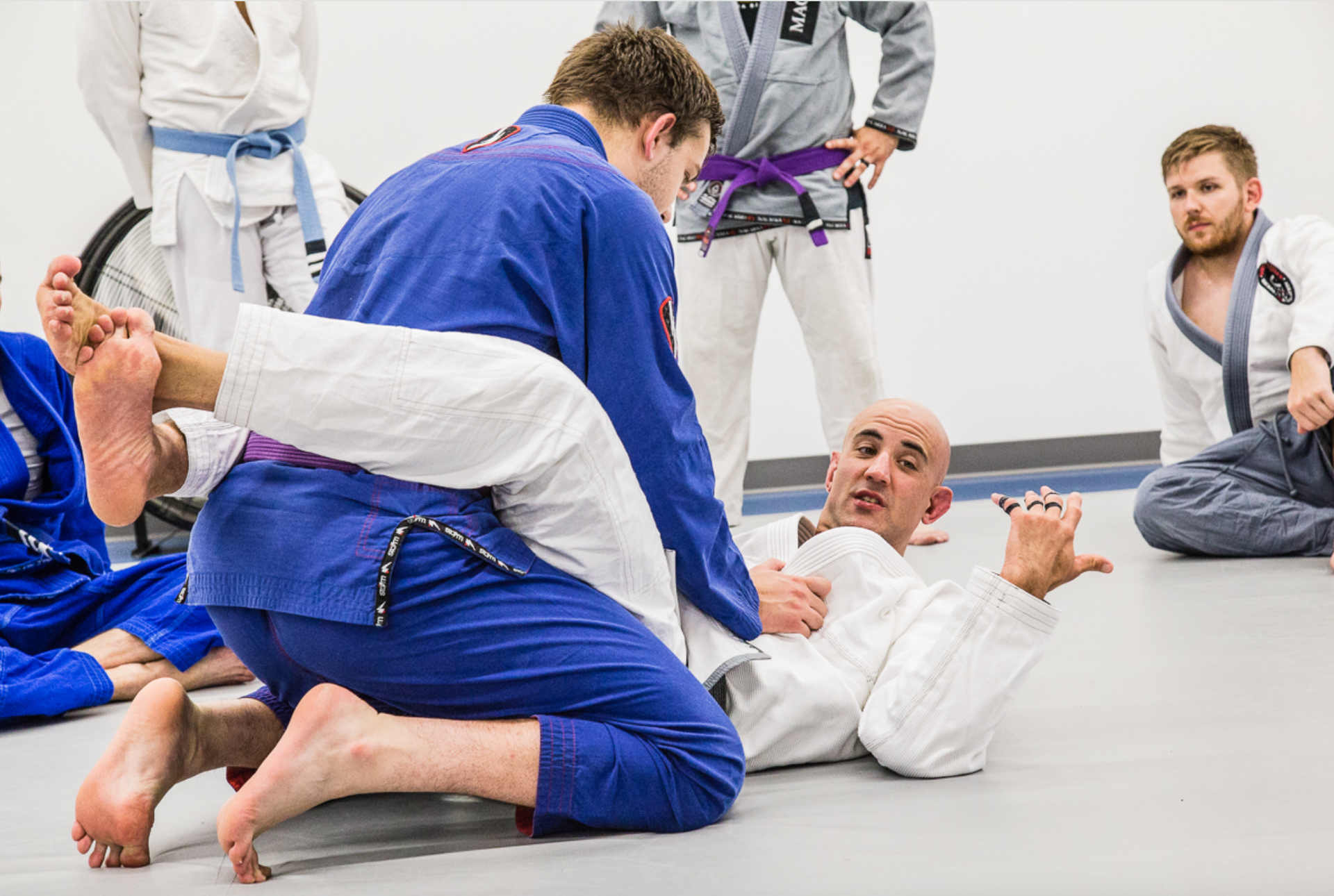
A well-run class can turn a loud, busy day into 60 minutes of focused effort, steady breathing, and a calmer brain afterward.
Stress shows up in Hamden the same way it does everywhere: tight shoulders at a desk, that mental loop you cannot turn off, the feeling that your day is happening to you instead of the other way around. Many adults start looking for something that feels real and structured, not another “just relax” suggestion. That is where Adult Jiu-Jitsu fits surprisingly well.
Adult Jiu-Jitsu is not magic, and we do not present it like therapy. But a consistent Brazilian Jiu-Jitsu practice can support stress relief through mechanisms that make sense: vigorous exercise, focused problem-solving, controlled physical contact, and a regular social routine. The result for many students is simple and practical: you walk out feeling more settled than when you walked in.
What Adult Jiu-Jitsu is, and what it is not
Brazilian Jiu-Jitsu is a grappling martial art built around leverage, position, and control. You learn how to manage common “stuck” situations on the ground, how to escape, and how to apply submissions safely with a partner who can tap to stop. In other words, you practice solving physical problems with clear rules and a built-in off switch.
It is also important to say what Adult Jiu-Jitsu is not. It is not a guaranteed cure for stress, and it is not a clinical treatment for anxiety, depression, or PTSD. Research on martial arts and combat sports is promising in some areas, but the strongest reviews highlight mixed results and lots of study limitations, including the fact that many studies are cross-sectional and cannot prove cause and effect. That is why we talk about stress support, not stress “elimination.”
If you already have a broader stress-management plan, training can complement it. If you are dealing with significant mental-health symptoms, we want you to keep professional care in the picture. Adult Jiu-Jitsu can be part of a healthy week, but it should not be your only tool.
Adult Jiu-Jitsu in Hamden: the eight-step stress-relief process (and what it feels like)
A good class does not just “happen.” It moves in stages, and each stage supports stress relief in a specific way. Here is the step-by-step framework we teach and reinforce, especially for beginners who want the mental benefits without getting overwhelmed.
1. Arrive and transition out of the workday
One of the most underrated parts of training is the transition. The few minutes between your car and the mat can become a mental doorway. We recommend arriving a little early, silencing notifications, and letting the day stop chasing you for a moment.
If you come in feeling rushed, that is normal. Most adults do. Over time, your brain starts pairing the routine with a calmer state: shoes off, gear on, line up, start moving. That consistency matters.
2. Warm up and regulate breathing
Warm-ups raise your body temperature, protect your joints, and set the tone. For stress relief, warm-ups also do something subtle: they force you back into your body. You cannot stay trapped in rumination when you are shrimping down the mat and trying not to hold your breath.
We coach beginners to notice breathing patterns early. The common stress response is to tense and brace, especially when something feels unfamiliar. In Brazilian Jiu-Jitsu in Hamden, learning to breathe under light pressure becomes a skill you can reuse outside the academy, like during a tense meeting or an overloaded commute.
3. Focus on one technical task
The fastest way to feel stressed in Adult Jiu-Jitsu is to try to learn everything at once. So we do the opposite. We narrow the target.
Instead of “get good at jiu-jitsu,” your goal for the night might be:
- Keep posture when you are in someone’s guard
- Build a frame and recover your guard
- Hit one specific escape and reset
A single technical focus turns class into a clear problem with boundaries. That is calming for a busy brain.
4. Use live practice as problem-solving, not a toughness test
Rolling (sparring) is where many adults either fall in love with jiu-jitsu or feel intimidated. The mindset matters. We frame rolling as problem-solving with a partner, not a fight and not an ego contest.
When you roll the right way, you practice reading cues: weight shifts, grips, hip angle, pressure changes. Your attention narrows naturally. That attention control is one of the most realistic stress-relief mechanisms in training, because it crowds out mental noise. You cannot mentally rehearse tomorrow’s stress while defending a pass and trying to breathe.
5. Learn to reset after setbacks
You will get tapped. You will lose position. You will blank on the move you drilled five minutes ago. That is not failure, it is the curriculum.
The stress-management lesson is the reset:
- Tap early and clearly
- Breathe
- Notice what happened without spiraling into self-judgment
- Start again with one small adjustment
That “reset skill” is one of the most transferable parts of Adult Jiu-Jitsu. It teaches you, physically and emotionally, that pressure is information. You respond, you adjust, you continue.
6. Connect with training partners (even briefly)
Adults often underestimate how much stress is social. When you feel isolated, stress hits harder. A consistent training routine builds repeated, low-pressure connection: fist bump, partner rotation, quick post-class conversation, learning names over time.
You do not need to be outgoing. You just need to show up. Community forms through shared effort, and grappling tends to speed that up because you are working together in a very real way, even when you are “competing” during rounds.
7. Track sustainable progress, not just wins
If stress relief is a goal, tracking progress only by taps or “who won” is a trap. We encourage beginners to measure what actually supports consistency.
Here are a few simple metrics that work well:
1. Weekly attendance (consistency beats intensity)
2. One technique you remember without prompting
3. One moment you stayed calm longer than last week
4. Recovery quality (sleep, soreness, energy)
5. A question you asked, even if it felt basic
Progress in Adult Jiu-Jitsu in Hamden is real, but it is not linear. Tracking the right things keeps you grounded, especially during the normal “I feel clumsy” phase of the first month.
8. Recover appropriately so training stays stress-relieving
There is a line between healthy stress (training) and too much stress (burnout). Recovery is what keeps the process working.
We want you to hydrate, eat enough, and take rest days when needed. We also want you to communicate with us about injuries, old shoulder issues, neck sensitivity, or anything that affects safety. Stress relief should not come at the expense of sleep or constant aches. You will train better, and feel better, when recovery is part of the plan.
What your first class can look like (especially if you are nervous)
Most adults are a little on edge before day one. Close contact is unfamiliar. The room looks intense from the outside. And yes, you might worry about being “the out-of-shape person.” We get it.
A beginner-friendly first class should feel structured. We start with basic movement and clear expectations: how to tap, how to move safely around other pairs, and how to choose an intensity that matches your experience. You will drill techniques with a partner under coaching, and we keep the atmosphere focused but welcoming.
Depending on the class and your comfort level, you may do controlled positional sparring or light rolling, or you may spend day one drilling and learning how rounds work. Either way, you are not expected to “prove” anything. You are here to learn.
Training safely and sustainably as an Adult beginner
Stress relief only happens when you feel physically safe. Good training culture is not accidental, so we teach safety habits right alongside technique.
A beginner safety checklist we reinforce
• Tap early, tap often, and never “tough it out” in a joint lock or choke
• Avoid sudden, explosive movements when you are new and unsure of positions
• Protect your neck by learning posture, frames, and smart head placement
• Choose training intensity intentionally, especially on tired days
• Tell us about injuries or limitations before class starts
• Keep hygiene standards high so close contact stays comfortable and respectful
If you are nervous about close contact, that is normal. Controlled grappling is not chaotic. It is coached, supervised, and built on consent and clear signals. Tapping is a shared language that keeps the room safe.
Research check: promising mechanisms, mixed clinical evidence
It is tempting to make big claims about martial arts and mental health. The more honest approach is also the more useful one.
A systematic review covering 72 studies of adult martial-arts and combat-sport participants found possible benefits in selected areas like coping skills, response inhibition, visuospatial perception, and some aspects of emotional regulation. At the same time, the same review found inconsistent or inconclusive evidence for anxiety, depression, self-esteem, attention, memory, and planning, and it noted that many studies were cross-sectional, meaning they cannot prove training caused the outcomes.
More recent qualitative research (interview-based work published in 2025) adds helpful real-world context: adult participants often describe stress relief, mindfulness, and psychological and social benefits that carry over into daily life. That aligns with what many students report in practice, even if the hard clinical proof is still developing.
BJJ-specific research is still limited. A five-month program involving U.S. service members and veterans was associated with reduced PTSD, depression, and anxiety symptoms, but the study did not include a comparison group, so it should be treated as preliminary. The takeaway is simple: Adult Jiu-Jitsu may support stress relief, but it should complement broader habits and, when needed, professional care.
Adult Jiu-Jitsu FAQs for Hamden adults
Is Adult Jiu-Jitsu suitable if I have never done martial arts?
Yes. We teach fundamentals step by step and assume you are new until you tell us otherwise. You will learn positions, movement basics, and how to work with partners safely.
Do I need to get in shape before starting?
No. Training is how you build conditioning. Expect the first couple of weeks to feel demanding, but you can pace yourself, take breaks, and improve gradually.
How often should a beginner train?
Two classes per week is a sustainable starting point for many adults. It is frequent enough to build skill and routine without crushing recovery. From there, you can adjust based on how your body feels and what your schedule allows.
Will Adult Jiu-Jitsu be too intense for stress relief?
It can be intense, but intensity is adjustable. You can roll lighter, choose controlled rounds, and focus on drilling. The goal is productive challenge, not exhaustion that makes your week harder.
Can Brazilian Jiu-Jitsu in Hamden help with anxiety?
It may help some people through exercise, focus, routine, and social connection, but current research in adults is mixed and does not prove a universal anxiety reduction effect. We view training as supportive, not as treatment.
What should I wear to class?
If you are training in the gi, you will wear a gi and belt once you have them, and for no-gi you will wear athletic clothing without zippers, pockets, or hard parts. If you are unsure, the website has guidance, and we can help you pick something workable for a first session.
When to seek professional support (and how training fits alongside it)
If stress is starting to affect sleep, relationships, work performance, or safety, we encourage you to talk with a qualified health professional. Adult Jiu-Jitsu can be a strong routine, a healthy outlet, and a place to practice staying calm under pressure, but it is not a substitute for clinical care.
Many adults do both: training for structure and community, professional support for deeper mental-health needs, and everyday basics like sleep, hydration, and boundaries. That combination is realistic and sustainable.
Take the Next Step with Soulcraft Martial Arts
If you want stress relief that feels active and practical, Adult Jiu-Jitsu gives you a clear hour where your only job is to breathe, move, and solve one problem at a time. At Soulcraft Martial Arts, we build that experience around progressive instruction, a supportive room culture, and training that meets you where you are.
When you are ready, we will help you start calmly, learn the basics safely, and turn class into a routine you can actually keep, even with work, family, and a full Hamden schedule.
New to Jiu-Jitsu? Start your training journey at Soulcraft Martial Arts.