
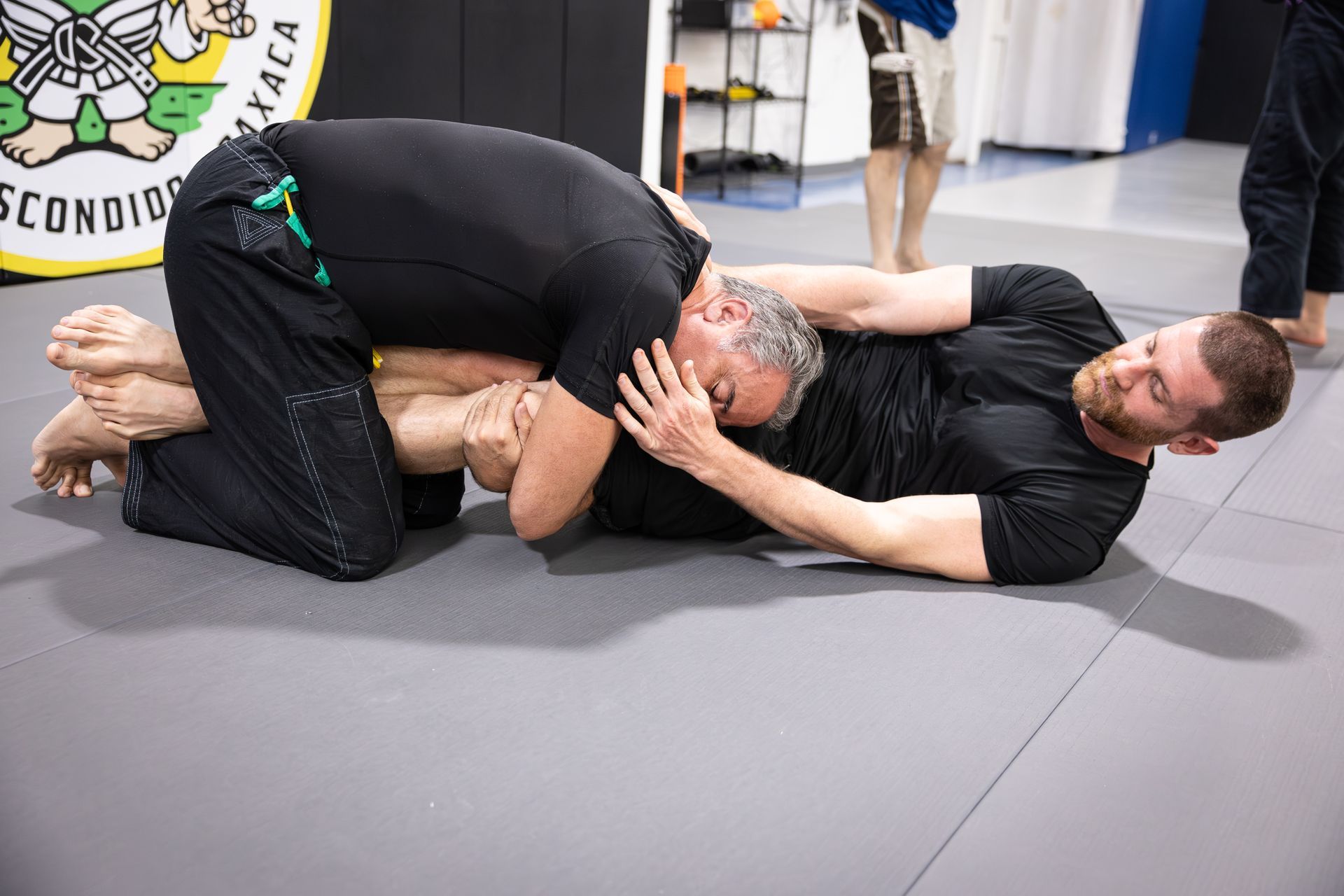
Adult Jiu-Jitsu gives you a rare mix of hard-earned confidence and real community, all in the same hour on the mats.
Adult Jiu-Jitsu has exploded in popularity across the U.S., and the numbers back it up: search interest for Brazilian Jiu-Jitsu has risen more than 104 over the last two decades, and the industry is now valued around 2.5 billion dollars. But those stats are just the surface. What matters day to day is what happens when you show up after work, learn something that feels awkward at first, and leave a little steadier than when you walked in.
In our Hamden classes, we see the same pattern: people start because they want fitness, self-defense skills, or a new challenge, and then they stay because the training builds resilience and the room starts to feel like a second home. Adult Jiu-Jitsu is physical, yes, but it is also a practice in staying calm, solving problems under pressure, and learning to trust training partners.
This article breaks down how Brazilian Jiu-Jitsu in Hamden helps you build mental toughness, protect your body while training smart, and form friendships that last well beyond the mats.
Why Adult Jiu-Jitsu keeps growing, and what that means for your training
Brazilian Jiu-Jitsu is no longer a niche hobby. In the U.S., there are tens of thousands of BJJ-related businesses and roughly 750,000 practitioners, with about 6 million worldwide. Interestingly, the supply of places to train has surged since 2020 while overall participation has stayed flat or dipped slightly, which tells us something important: people are choosing quality, culture, and experience, not just a logo on a sign.
That trend lines up with what we focus on in our Adult Jiu-Jitsu program. Technique matters, of course, but adults also need a place where training fits real life: jobs, kids, old shoulder tweaks, stress, and all. When the environment is supportive and coaching is consistent, you improve faster and you actually enjoy showing up, which is the whole point.
Resilience is trained, not wished for
Resilience is one of those words people toss around, but on the mats it becomes very real and very measurable. You can feel it when you stop panicking in a bad position. You can see it when you return after a rough week and still do the work. In Adult Jiu-Jitsu, resilience is not motivational speech. It is reps.
Learning to stay calm under pressure
One of the first big lessons in Brazilian Jiu-Jitsu in Hamden is that discomfort is not danger. You learn what tight pressure feels like, what fatigue feels like, what it means to breathe and think anyway. That carries over into everyday life more than most people expect.
We coach you to build a simple habit: pause, breathe, frame, and improve position. It sounds like a technical sequence, but it is also a mental sequence. Instead of reacting emotionally, you gather information and take the next best step. Do that for a few months and you will notice it showing up in meetings, traffic, and stressful conversations.
Small failures that build durable confidence
Adults often avoid beginner activities because being new is uncomfortable. Jiu-Jitsu flips that. You will tap. You will forget steps. Sometimes you will feel clumsy. And then, gradually, you will remember one detail and it will work. That cycle is confidence you can actually trust, because it is built from real feedback, not hype.
A typical milestone we see is when a student gets stuck less often, not because life got easier, but because problem-solving improved. That is resilience in practice.
The body benefits are obvious, but the mental benefits sneak up on you
Adult Jiu-Jitsu is a full-body workout. You build grip strength, hip mobility, core stability, and conditioning without staring at a clock the whole time. Classes usually include technique instruction and then live training, often called rolling, where you apply what you learned.
What surprises many adults is the mental health impact. Research has pointed to sustained decreases in PTSD symptoms for veterans and first responders who train consistently, likely due to the combination of intense physical activity, focused attention, and social connection. Even if PTSD is not part of your story, the same ingredients help with day-to-day stress.
When you roll, you cannot multitask. You are not scrolling, not answering emails, not replaying the day. Your attention narrows to posture, balance, timing, and breathing. For many adults, that focus is the first real mental quiet they get all week.
How lasting friendships form in close-contact training
It is hard to fake connection in a room where people are learning something challenging together. Adult Jiu-Jitsu has a built-in honesty to it: you have to cooperate to train safely, and you have to communicate to get better.
Friendship in a jiu-jitsu room usually starts small. You drill with someone a few times. You learn each other’s pace. You joke about the same detail you keep messing up. Then you start asking each other questions, sharing tips, and celebrating progress.
Over time, the bonds get deeper because you are seeing each other at your most human: tired, learning, struggling, improving. That is a different kind of social connection than casual small talk. It is earned.
Why the culture matters more than people realize
Because studios have become more common, culture is what makes people stay. We work intentionally to keep training welcoming, structured, and respectful. Adults should be able to train hard without feeling like the room is a test of ego.
That shows up in how we match partners, how we coach intensity, and how we normalize tapping early. You can train seriously and still be kind. In fact, you train longer that way.
What a typical Adult Jiu-Jitsu class looks like in Hamden
Most adult classes run about 60 to 90 minutes. While the exact flow can vary by day, our structure is designed to help you learn, practice, and then pressure-test in a controlled way.
Here is what you can generally expect:
- A warm-up that supports joint health, mobility, and safe movement patterns for grappling
- Technique instruction with clear coaching points, including what to do and why it works
- Partner drilling where you repeat the movement and refine details at a manageable pace
- Live rounds where you roll with training partners under supervision, applying techniques safely
- A quick cool-down and time to ask questions, especially if something did not click yet
If you are brand new, we help you settle in. Nobody needs to “survive” a first class. You need a good start, good habits, and a clear next step.
Safety, injuries, and how we help you train for the long run
A fair question we hear is: Is Jiu-Jitsu safe for adults? The honest answer is that it is a contact sport with a known injury profile, but it can be managed well with smart coaching and responsible training choices. Data from emergency department visits shows sprains and strains are the most common injuries, and shoulder and upper trunk issues show up often, with the average injured practitioner around the mid-20s.
Adults in their 30s, 40s, and 50s can still thrive in Adult Jiu-Jitsu. The key is training with a long-term mindset.
Practical ways we reduce risk without watering down training
We keep safety concrete, not vague. That means:
1. We teach tapping as a skill, not as a last resort, so you protect joints early
2. We emphasize positional control and clean mechanics before speed and strength
3. We coach partner selection and intensity, especially for newer students
4. We build warm-ups that support shoulders, hips, neck, and knees, which are common stress points
5. We encourage recovery habits like sleep, hydration, and mobility work because adults are not indestructible
If you have an old injury, we can scale training and help you choose positions and strategies that keep you moving forward. Consistency beats intensity when the goal is progress that lasts.
Gear and what you actually need to start
You do not need a shopping spree to begin. For early sessions, you can often start with athletic shorts and a t-shirt, depending on the class format. If you continue, you will eventually want a gi for gi classes, which is part of a growing global market and a core part of traditional Brazilian Jiu-Jitsu in Hamden training.
We also recommend basic hygiene and safety items: trimmed nails, no jewelry, and a water bottle you actually use. Small habits make training better for everyone.
Adult goals are different, so our coaching has to meet you there
Adult Jiu-Jitsu students show up with different motivations. Some want a demanding workout. Some want self-defense skills. Some want a hobby that feels meaningful. Some want stress relief that does not involve sitting still.
We build our coaching around adult realities:
- You may train two to four times a week, not twice a day like a full-time competitor
- You need skills that work under pressure, not just in perfect drills
- You want a welcoming community, not a room full of unchecked ego
- You want a schedule that fits work and family, which is why the class schedule matters as much as the curriculum
And for some students, pairing grappling with striking-based self-defense is part of the plan. If you are also curious about Adult Krav Maga in Hamden, we can help you understand how it complements grappling, especially around awareness, decisiveness, and real-world context.
How resilience shows up outside the gym
The biggest payoff of Adult Jiu-Jitsu is that it changes how you handle hard moments. You learn to separate discomfort from danger. You learn to breathe when you want to rush. You learn to keep working when the first plan fails.
People often tell us the effects show up in simple ways:
- Better posture and less tension in shoulders and jaw during stressful days
- More patience when things do not go your way immediately
- A calmer response to conflict, because you have practiced staying composed
- Stronger boundaries, because you get used to saying “tap” and respecting “tap”
Those are not abstract benefits. They are skills you practice every week.
Take the Next Step
If you want training that builds real composure, real fitness, and real connection, our Adult Jiu-Jitsu program is built for exactly that. At Soulcraft Martial Arts, we keep the coaching practical, the culture welcoming, and the training challenging in a way that helps you come back tomorrow.
Whether your goal is Brazilian Jiu-Jitsu in Hamden for resilience, a supportive community you can count on, or a well-rounded plan that may also include Adult Krav Maga in Hamden, we will help you start with a clear path and steady progress.
Build stronger fundamentals and sharpen your technique by joining a Brazilian Jiu-Jitsu class at Soulcraft Martial Arts.