
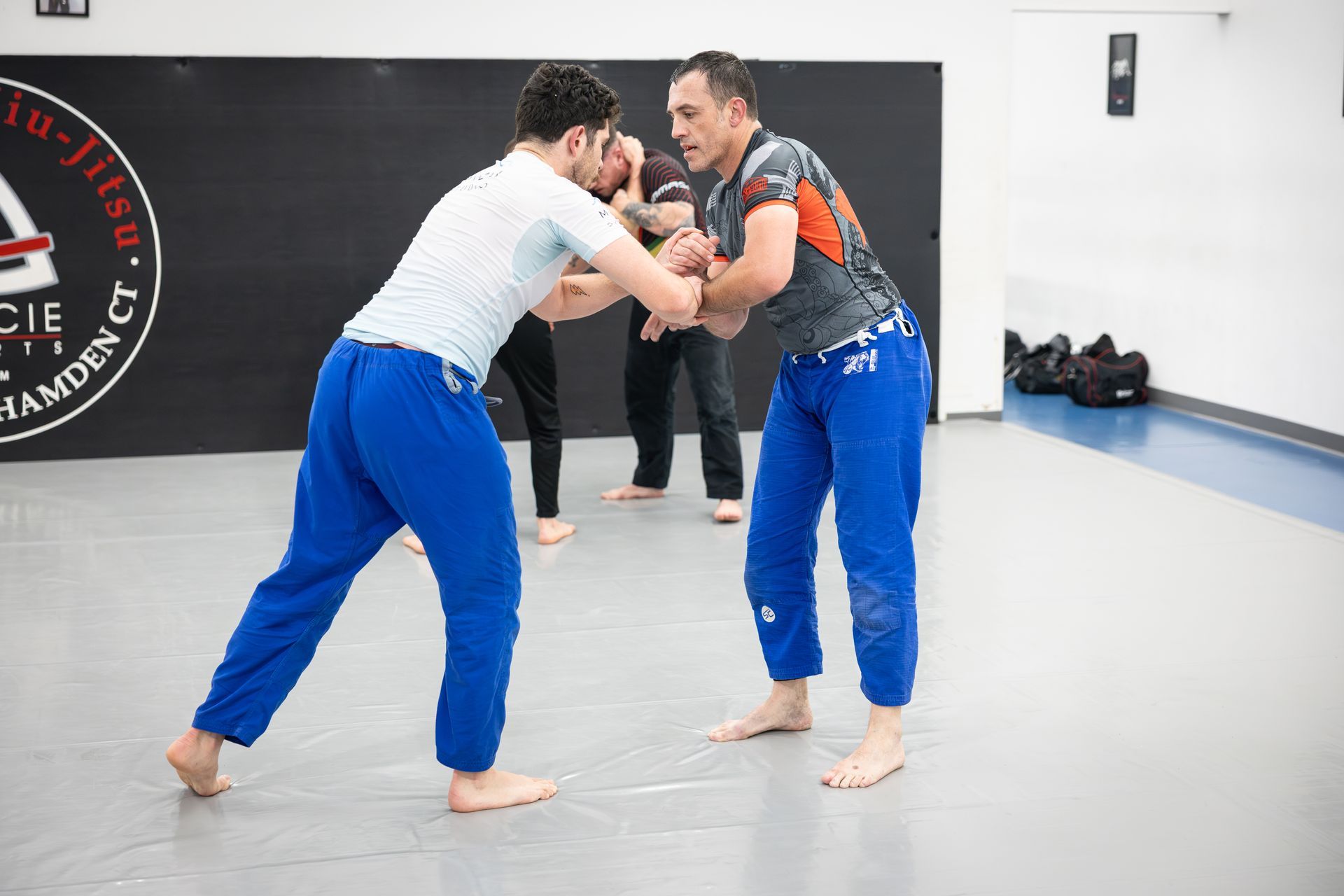
Adult Jiu-Jitsu can be one of the most practical ways to get stronger, move better, and feel more capable in your own body.
Adult fitness is tricky because most of us are not starting from a blank slate. You might sit at a desk all day, commute, chase kids around, or feel that familiar stiffness when you stand up after being still too long. That is why Adult Jiu-Jitsu appeals to so many people in Hamden: it is movement with a purpose, taught in a structured way, and it tends to build real-world “usable mobility” instead of chasing extreme flexibility.
In our Adult Jiu-Jitsu classes, you are not just doing random exercises. You are practicing transitions: getting up and down, rotating your hips, using your hands to frame and grip, and learning to move under light to moderate resistance. Over time, that kind of training can help many adults feel less fragile, more coordinated, and more comfortable in positions that used to feel awkward on the joints.
That said, we keep the conversation honest. Training can support mobility and joint-friendly fitness, but it is not a magic cure for arthritis or chronic joint conditions. If you have persistent, sharp, worsening, or unstable pain, it is smart to get guidance from a qualified healthcare professional and then train with appropriate modifications.
What Adult Jiu-Jitsu actually looks like in a real class
When people hear “jiu-jitsu,” they sometimes imagine constant hard sparring. In reality, a well-coached adult program is usually a blend of learning, drilling, and gradually adding resistance. Adult Jiu-Jitsu is a full-body activity: standing entries, controlled takedown concepts, kneeling transitions, seated guard work, bridging, hip movement, and a lot of pushing and pulling through frames and grips.
A typical class flow is simple and surprisingly approachable once you see it in person. We warm up progressively, practice movement patterns that show up constantly in Brazilian Jiu-Jitsu in Hamden, and then focus on a small set of techniques that connect to each other. Instead of doing a hundred things halfway, we would rather help you learn a few things well and repeat them enough to feel your body “get it.”
For adults who want mobility benefits, those repeated transitions matter. The floor-based nature of grappling means you get lots of practice moving your spine, hips, and shoulders through angles that daily life does not always demand, especially if you spend most of the day sitting.
Why Adult Jiu-Jitsu can improve mobility and movement confidence
Mobility is not only about range of motion. It is also about control, strength at the edges of your range, balance, and confidence when your body is under pressure. Adult Jiu-Jitsu in Hamden often helps because it trains all of those pieces at once, but in a progressive way.
You practice “everyday athleticism” on purpose
A lot of adults realize they are losing mobility when they have to get up off the floor, twist to grab something, or catch themselves when they trip. In jiu-jitsu, you practice versions of those skills constantly: technical stand-ups, hip escapes, bridging, and base changes. These are not circus tricks. They are practical movement patterns you repeat until they feel normal again.
You move through multiple positions, not just one plane
Many workouts stay very linear: straight ahead running, up-and-down lifting, or machine-based training that locks you into a path. Adult Jiu-Jitsu is different. You rotate, hinge, shift weight laterally, and learn to create space with your hips and shoulders. That variety is one reason some adults notice that their body feels “less stuck” after a few months of consistent training.
Resistance is adjustable, which makes mobility more usable
Stretching can help, but mobility becomes more reliable when you can express it under a little resistance without panicking or tensing up. Partner drills let us dial intensity up or down. If your knee is cranky that day, we can change the pace, adjust the position, or choose a different training partner so you can still train without turning it into a fight with your joints.
Joint pain and Jiu-Jitsu: what we can say responsibly
A lot of people search Adult Jiu-Jitsu because their knees, shoulders, hips, or back feel stiff and sore. It is tempting to promise relief, but we take a more responsible approach: training may help you build strength around joints, improve movement options, and reduce fear around certain positions. Those factors can change how your body feels day to day.
What we will not do is claim that training “cures” arthritis, fixes cartilage, or guarantees pain-free movement. Joint pain is personal. Some discomfort comes from weakness or inactivity, some from old injuries, and some from medical conditions that need a clinician’s input. The best outcome comes from combining smart coaching, good communication, and patient progression.
A useful way to think about it is this: we train to improve capacity. When your hips are stronger, your core is more responsive, and your shoulders are supported by better mechanics, you often have more options. More options usually means less irritation, because you stop forcing the same angles over and over.
How controlled training supports strength around the joints
Adult Jiu-Jitsu is not a weightlifting program, but it can develop very real strength and stability because your body has to coordinate as one unit. That matters for joints, because joints like support. Strong muscles and better timing can reduce the sense that a joint is doing all the work alone.
Here are a few joint-related examples we see often in Adult Jiu-Jitsu in Hamden:
• Knees: learning to align your knee when changing levels, building stronger hips and hamstrings through bridging and base work, and choosing safer angles when passing or playing guard
• Shoulders: improving scapular control through framing and posture, learning when to relax versus strain, and tapping early to avoid extended end ranges
• Hips and low back: using hip movement and core engagement instead of yanking with the spine, plus practicing safe rotation and posture under pressure
• Neck and ribs: developing better breathing habits and calmer movement so you do not tense up and spike your own effort unnecessarily
We also remind adults that “more intensity” is not always “more progress.” Joint-friendly training usually means you build the habit first, then gradually increase rounds, resistance, and complexity.
What the research says about BJJ injuries (and why we talk about it)
Brazilian Jiu-Jitsu is not risk-free. A 2024 systematic review that covered seven studies and 2,847 practitioners reported commonly affected areas including the knee, chest or rib region, and shoulder. It also found higher injury rates among beginners and men older than 30, particularly during training. That is not meant to scare you off. It is meant to guide how you start.
We would rather earn your trust by being clear: the goal is not to avoid all discomfort forever, because training is physical. The goal is to reduce preventable injuries through coaching, pacing, and smart partner work. For many adults, the biggest risk is not the art itself, but doing too much too soon or treating every round like it has a scoreboard.
If you are brand new, you will get more out of focusing on movement quality and defense first. That is usually where mobility improves the fastest anyway, because you are learning to move efficiently instead of muscling everything.
A joint-friendly beginner framework we use in Adult Jiu-Jitsu
Beginners do best with a simple plan: learn how to move, learn how to stay safe, then slowly add intensity. When you are dealing with stiffness or old injuries, that progression matters even more.
Here are a few practical ways we keep Adult Jiu-Jitsu beginner-friendly and more joint-aware:
• We scale intensity by adjusting rounds, pace, and how much resistance your partner gives you
• We choose starting positions that reduce impact and chaotic scrambles when you are learning
• We encourage tapping early, especially while you are still learning what “too far” feels like
• We help you pick training partners who can stay controlled and technical
• We modify drills that aggravate symptoms, rather than forcing you through them
• We build warm-ups around progressive movement, not sudden max effort
If you tell us, “My shoulder is touchy,” or “My knee does not love deep angles,” we can work with that. What matters is that you communicate early, because that gives us room to coach you intelligently.
Soreness vs pain: how to tell the difference
A little soreness is normal when you start Adult Jiu-Jitsu, especially if you have not used your hips, core, and grip strength in a while. You might feel general muscle fatigue, mild stiffness the next day, or a sense that your whole body got a workout. That is expected.
Pain is different. If you feel sharp, catching, stabbing, or radiating pain, or you notice swelling, numbness, instability, or reduced function, stop and tell us. The same goes for pain that worsens session to session instead of settling down with rest. We can modify training, but you may also need a medical evaluation to understand what is going on before you push further.
Learning to respect that line is part of training like an adult. It is not “being soft.” It is being consistent, and consistency is what actually changes mobility over time.
Gi vs No-Gi: which is better for mobility?
We offer both gi and no-gi training, and neither one is automatically “the mobility option.” They simply stress you differently.
Gi training often involves more gripping and slower, more methodical control. That can be helpful if you want a steadier pace, but it can also be demanding on fingers, elbows, and shoulders if you death-grip everything. No-gi tends to move faster with different types of holds, which some people find easier on the hands but more demanding on cardio and scrambling control.
If your goal is Adult Jiu-Jitsu for mobility and joint-friendly fitness, we usually recommend starting where you feel most comfortable and then building a balanced practice. The best choice is the one that keeps you training consistently without irritating your problem areas.
What to expect in your first Adult Jiu-Jitsu class in Hamden
Your first class should feel structured, not like you got tossed into the deep end. We will guide you through the basics and keep the pace manageable. You do not need to be flexible, you do not need to “win,” and you definitely do not need to prove toughness.
Here is what you can expect the first time you show up:
1. You will get a quick orientation on safety, tapping, and how partner drills work
2. We will start with a progressive warm-up focused on fundamental movement
3. You will learn a few core positions and escapes that help you feel less stuck
4. You will practice with a partner in a controlled way, with coaching throughout
5. You will have time to ask questions and talk through any limitations
If you are worried about a knee, shoulder, or back issue, say it up front. Adult Jiu-Jitsu in Hamden should meet you where you are, not where you think you “should” be.
Questions to ask yourself before you start
You do not need to overthink it, but a little clarity helps you train smarter. Ask yourself:
• Do I want better day-to-day movement, or am I chasing intense competition right away?
• Which joints bother me most, and what movements tend to aggravate them?
• How many days per week can I train and still recover well?
• Am I willing to tap early and learn patiently, even when my ego flares up a bit?
When you have those answers, we can help you shape training around your goals. Mobility gains often come from doing the basics consistently, not from collecting advanced moves.
Ready to Begin
If you want a training routine that builds usable mobility, strength, and confidence without pretending your joints are indestructible, our Adult Jiu-Jitsu program is built for that. We focus on coached progress, controllable intensity, and the kind of movement practice that carries over into the rest of your week, not just the hour you are on the mats.
At Soulcraft Martial Arts, we work with adults across Hamden and New Haven County who are starting from all kinds of baselines, including stiffness, old injuries, or a long break from exercise. If you are ready to move better and train smarter, we would love to help you take the first step.
Challenge yourself physically and mentally through consistent Jiu-Jitsu training at Soulcraft Martial Arts.