
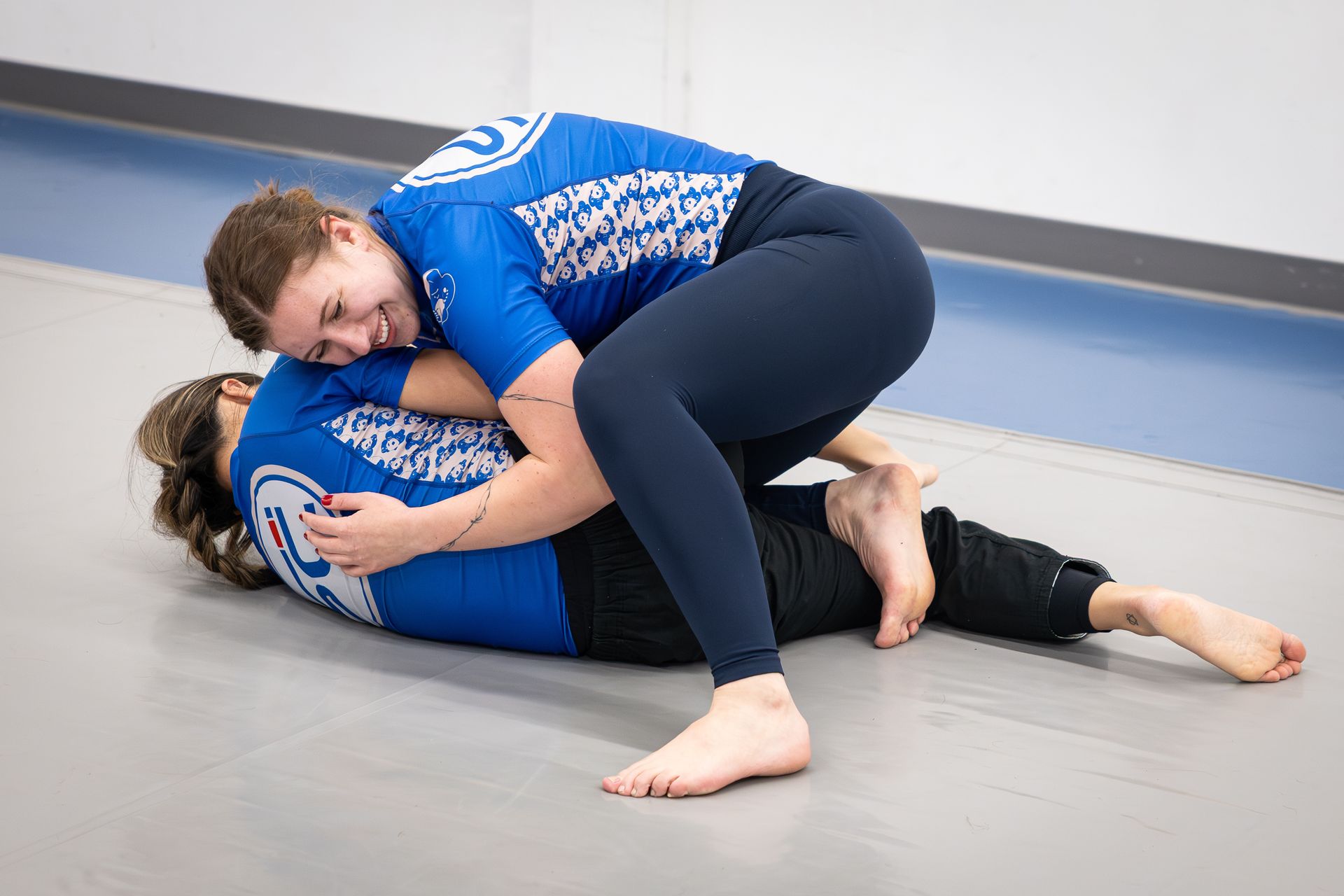
Adult Jiu-Jitsu gives you a place to practice staying calm on purpose, even when life feels loud.
Adult Jiu-Jitsu attracts a lot of Hamden adults for a simple reason: most of us want more than “another workout.” You can lift, run, and stretch, but stress still finds a way to tag along. Adult Jiu-Jitsu is different because it asks for your full attention, and that changes how your mind handles pressure.
In our Adult Jiu-Jitsu classes, you’ll move, think, problem-solve, and reset your breathing in real time. That mix matters. When your body is working and your brain is engaged, it becomes harder for anxious thoughts to loop unchecked, and easier to focus on what’s actually happening right now.
This article breaks down how Adult Jiu-Jitsu in Hamden can support mindset change and everyday anxiety relief, what a beginner experience looks like, and how we keep training structured, safe, and beginner-friendly.
What Adult Jiu-Jitsu actually is (and what it is not)
Adult Jiu-Jitsu is grappling, but it’s not “brawling.” In Brazilian Jiu-Jitsu, you learn how to control position, create leverage, escape bad spots, and apply submissions with control. The goal is skill, not chaos.
Most importantly, training has clear rules: you can tap to stop at any time, you can ask to slow down, and you can choose training intensity based on where you are that day. That structure is a big reason Adult Jiu-Jitsu can feel surprisingly grounding for people who carry stress or anxiety.
What Adult Jiu-Jitsu is not:
- It’s not a requirement to compete.
- It’s not a toughness contest.
- It’s not a replacement for therapy or medical care.
We love what training can do for mindset, but we’ll always frame it as a supportive practice, not a clinical treatment.
Why anxiety often improves when your attention has somewhere to go
Anxiety is often fueled by future-focused thinking: What if I mess up, what if something goes wrong, what if I can’t handle it. On the mat, you don’t get to live five steps ahead for long. You have grips to address, balance to manage, breathing to control, and timing to learn. Your attention gets pulled into the present because it has to.
Present-moment focus you can actually feel
During a round, you’re tracking:
- Your posture and base
- Your frames and grips
- Your partner’s weight shifts
- Your breathing and pace
- The next small decision
That kind of focus isn’t abstract. It’s physical. And for many adults, that’s the first time in the day where the mind stops roaming and starts doing one thing at a time.
Exercise plus problem-solving hits differently
A treadmill can be meditative, but it can also leave plenty of room to ruminate. Brazilian Jiu-Jitsu in Hamden (especially in an adult beginner pathway) tends to be mentally “sticky” in a good way. You’re learning patterns, testing them, adjusting, and trying again. When you leave class, you’re tired, but it’s a calmer tired, not just drained.
Calm under pressure: the most practical mindset skill you can train
One of the biggest mental shifts we see in Adult Jiu-Jitsu is learning the difference between discomfort and danger. In daily life, anxiety can blur that line. Your body reacts as if everything is urgent, even when it isn’t.
In training, you practice staying functional while uncomfortable:
- Someone is applying pressure from the top
- You feel stuck for a moment
- You notice your breath speeding up
- You choose a small, technical action anyway
Over time, your nervous system gets repeated proof that pressure does not automatically mean panic. You can breathe, think, and respond. That’s a powerful mindset upgrade, and it tends to show up outside the gym too: tough meetings, tense conversations, traffic, parenting stress, you name it.
“Controlled discomfort” with an off switch
A big reason Adult Jiu-Jitsu can be anxiety-aware is the tap. If something feels wrong, overwhelming, or painful, you tap and the action stops. That simple agreement creates psychological safety, especially for beginners. You’re not trapped. You’re learning with boundaries.
Confidence that’s earned, not hyped up
There’s a certain kind of confidence that comes from motivational talk, and there’s another kind that comes from doing hard things in small doses until you can do them. Adult Jiu-Jitsu builds the second kind.
Beginners experience “failure” constantly at first, and that’s not a flaw in the process, it’s the process. You’ll get put in unfamiliar positions, forget steps, and feel awkward. Then you learn one escape. One frame. One grip break. And suddenly you’re not helpless in that spot anymore.
That’s self-efficacy in real life: the belief that you can figure things out, even when you’re stressed.
What research suggests about Brazilian Jiu-Jitsu and mental health
The conversation around Brazilian Jiu-Jitsu in Hamden often starts with fitness or self-defense, but research interest has been expanding into psychology. Recent studies have examined traits like resilience, grit, self-control, self-efficacy, and life satisfaction in BJJ practitioners.
Here’s the responsible way to read that research: it’s encouraging, but not magic, and not proof that BJJ “treats” anxiety disorders.
A 2025 study of 420 BJJ athletes ages 18 to 60 looked at resilience, grit, self-efficacy, self-control, aggression, life satisfaction, and mental-health indicators. The study found significant associations between factors like self-control, life satisfaction, and resilience and mental-health outcomes. In male participants, measured factors explained about 51.7 percent of the variance in mental-health-disorder scores. That’s meaningful, but it’s still correlation, not a clinical prescription.
Other observational work has found that higher belts report stronger mental skills and better mental-health indicators than lower belts, but again, that doesn’t prove training alone caused the difference. It may also reflect who sticks with training long enough to earn advanced ranks.
There’s also smaller, promising research in specific populations, like a study of disabled combat veterans that reported reductions in PTSD symptoms and increases in resilience after BJJ participation. The sample was only 16 people, so it’s best viewed as hopeful, not definitive.
Our takeaway: Adult Jiu-Jitsu can be a structured practice for building habits that support stress management. If you’re dealing with clinical anxiety, panic, trauma, or depression, we encourage you to train and also work with a qualified mental-health professional.
Why Adult Jiu-Jitsu in Hamden fits busy adult life
Hamden adults are balancing commutes, family schedules, work stress, and the mental load of keeping everything moving. A program only works if it’s realistic. Adult Jiu-Jitsu can slot into adult life because it’s scalable: you can train hard, or you can train intelligently and steadily, and still make progress.
We also find that training becomes a clean transition point in your day. You walk in carrying whatever you’re carrying, you train with focus for an hour, and you leave with a clearer head. It’s not that stress disappears, but it often feels more manageable, like the volume got turned down.
Progress you can measure beyond belts
Belts matter, but they’re not the only win. Early progress often looks like:
- Showing up consistently for a month, even when motivation dips
- Breathing through a tough position instead of holding your breath
- Learning one reliable escape you can hit under pressure
- Rolling with better body awareness and less tension
- Recovering emotionally after a rough round and trying again
Those are mindset reps, and they add up.
An anxiety-friendly guide to your first Adult Jiu-Jitsu class
If you feel nervous in group settings, the unknown is usually the hardest part. We keep the process predictable because predictability reduces stress.
Here’s what a typical first class experience looks like in our Adult Jiu-Jitsu program:
1. You arrive a little early so we can get you oriented, answer questions, and help you feel settled.
2. We’ll point you to where to put your stuff, where to fill your water, and what to expect that day.
3. Class starts with a warm-up that’s meant to prepare joints and movement patterns, not punish you.
4. We teach technique step by step, with time to ask questions and repeat it at a comfortable pace.
5. You practice with a partner in a controlled drill, and we help match you with someone appropriate.
6. If sparring is part of the day, we’ll explain the goal and expectations clearly, and we can scale intensity.
If you need a break, you can take a break. If you’re unsure about something, you can ask. You won’t be singled out for being new, because being new is normal here.
What to wear to your first class
Wear comfortable athletic clothing without zippers, buttons, or hard objects. Bring water. If you have questions about gear like a gi, you can check the website or ask us before class so you don’t overthink it.
Safety basics: tapping, communication, and smart training intensity
No contact sport is risk-free, and we won’t pretend it is. What we can do is run Adult Jiu-Jitsu with clear safety standards, consistent coaching, and an environment where communication is normal.
The safety habits we coach from day one
- Tap early and tap clearly, and stop immediately when your partner taps
- Prioritize control over speed, especially as a beginner
- Use good hygiene and clean gear so the mats stay safe for everyone
- Train with appropriate partners and speak up if something feels off
- Warm up with purpose to protect joints and reduce preventable strains
If you’re coming in with old injuries, limited mobility, or a high-stress season of life, tell us. We can suggest modifications and pacing so you can train consistently without burning out.
If you feel claustrophobic
This is more common than people admit. Close contact can feel intense at first. The good news is that you can approach it gradually. You can start with drills, choose calmer partners, tap immediately when you need to, and build comfort step by step. No one should pressure you to “push through” distress.
Practical FAQ for adults thinking about starting
Do I need to be in shape before starting Adult Jiu-Jitsu?
No. Training helps you get in shape. We can scale intensity, and you can rest between rounds as needed.
Will I have to fight or compete?
No. Competition is optional. Adult Jiu-Jitsu can be purely recreational, focused on skill, fitness, and stress management.
How often should I train as a beginner?
Twice per week is a strong starting point for many adults. Consistency beats intensity, especially early on.
Can Adult Jiu-Jitsu replace therapy or medication for anxiety?
No. It can support your overall well-being, but it’s not a substitute for professional care. If you’re struggling, keep that support in your plan.
What if I’m over 30, 40, or 50?
You can absolutely start later. The key is smart pacing, good coaching, and training with partners who value control.
Ready to Train at Soulcraft Martial Arts
Building a calmer mindset rarely comes from one big breakthrough. It usually comes from repetition: showing up, practicing under pressure, and learning that you can handle more than you thought. That’s exactly what we aim to give you in our Adult Jiu-Jitsu in Hamden program: a structured place to train your body and your responses at the same time.
If you want a practice that supports confidence, focus, and everyday anxiety relief without requiring a competitive personality, we’d love to help you get started at Soulcraft Martial Arts, right here in Hamden.
Turn your interest in Jiu-Jitsu into action with training at Soulcraft Martial Arts.