
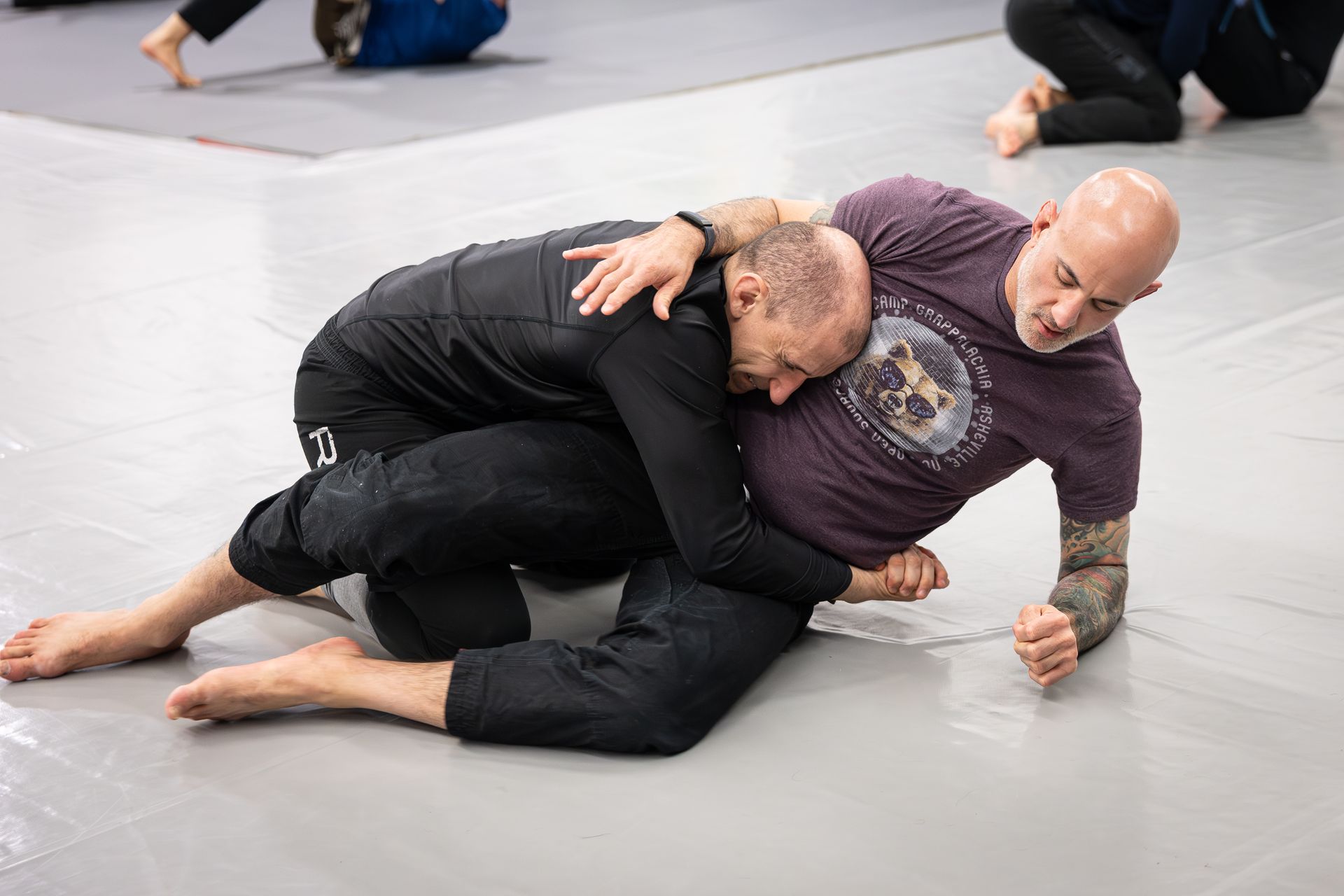
Jiu-Jitsu gives you a realistic way to get stronger, think clearer, and carry yourself differently in daily life.
If you live in Hamden and you want a workout that actually teaches a skill, Jiu-Jitsu checks a lot of boxes at once. You get a challenging training session, but you also get a practical education in leverage, balance, and control. And because Brazilian Jiu Jitsu in Hamden is built around technique more than raw athleticism, you do not need to arrive already in shape to start.
We also see a common pattern with adults: you might be busy, a little stressed, and tired of fitness plans that rely on motivation alone. Jiu-Jitsu works differently. It gives you a clear structure, a measurable path forward, and enough mental engagement that the hour goes by fast. Most people walk out feeling more energized than when the class started, which is not what you expect from hard training.
Adult Jiu-Jitsu in Hamden has grown quickly in the last few years, and we understand why. People want low impact conditioning that still feels intense, plus something that helps with focus and confidence. When training is done the right way, it is sustainable, safe, and surprisingly addictive in a good way.
Why Jiu-Jitsu works so well for adult fitness
Jiu-Jitsu is often described as problem-solving with your body. On the mat, you are constantly making small decisions: where your hips are, how you are framing, when to move, when to stay still. That continuous decision-making is one reason training improves focus. You cannot scroll your brain through a class and still do well, even on easy days.
From a fitness standpoint, the training hits multiple goals without you needing a separate plan. You develop strength through holding posture, controlling positions, and moving efficiently. You build cardio through rounds that come in waves, effort, recover, effort again. And because we emphasize technique and control, you can train consistently without feeling wrecked after every session.
We also like that Brazilian Jiu Jitsu in Hamden is friendly to different starting points. Some adults arrive with a sports background. Others have not trained since gym class. Jiu-Jitsu gives both people a way to progress because good technique scales. As you improve, you rely less on muscling through and more on timing and leverage, which is exactly how the art is designed.
Fitness you can feel outside the gym
A good training program should show up in your life, not just in a mirror. Adults often tell us the first changes they notice are practical: better posture at a desk, less stiffness when getting out of a car, more stable knees and hips on stairs. Those are not flashy outcomes, but they are real.
Jiu-Jitsu also builds a kind of durable strength. It is not just lifting strength. It is the ability to hold alignment, breathe under pressure, and keep working when things get uncomfortable. That carries into everyday tasks, from yardwork to playing with kids to simply having more energy at the end of a workday.
And yes, weight loss can happen too, especially when you train consistently. But we prefer to frame fitness as performance and sustainability. When you focus on learning, showing up, and getting a little better each week, the physical changes tend to follow naturally.
Focus, stress relief, and the mental reset adults need
A lot of adult life is mental clutter. Meetings, notifications, errands, family schedules. Jiu-Jitsu creates a rare pocket of time where your attention has one job: solve the problem right in front of you. That is a powerful stress reliever because it interrupts the constant background noise.
We structure classes so you get that mental reset without chaos. You learn a technique with a clear goal, you drill it, and you add resistance gradually. That progression trains your attention. You practice staying calm, noticing details, and adapting. Over time, that skill transfers. People report feeling more patient in traffic, more composed during conflict, and more confident speaking up when it matters.
There is also something simple and human about training with other adults who are working hard too. You get community without forced small talk. You learn names, you share the struggle of a tough round, and you leave class feeling lighter.
Everyday confidence through practical self-defense
Confidence is not about pretending you are unstoppable. For most adults, confidence comes from knowing you can handle yourself if something goes wrong, and also knowing how to avoid situations before they escalate. Jiu-Jitsu supports both.
Because Brazilian Jiu Jitsu in Hamden emphasizes controlling positions on the ground, you learn how to protect yourself when distance closes. You develop skills like staying on your side instead of flat on your back, using frames to create space, standing up safely, and controlling someone without needing to strike. Those are practical outcomes, and they matter.
In our approach, control is a safety tool and a self-defense tool. You learn when to disengage, when to stabilize, and how to keep yourself protected while you make decisions. That is what everyday confidence looks like: not aggressive, not performative, just prepared.
What to expect in our adult program
If you are new, the first thing you should know is that you will not be thrown into the deep end on day one. Our adult classes are beginner-friendly by design. We teach fundamentals, we repeat the important details, and we coach you through the parts that feel awkward at first, like shrimping, bridging, and learning how to relax while you work.
A typical class includes technical instruction, drilling for repetition, and optional sparring that matches your experience level. Sparring is where timing and decision-making improve fastest, but we treat it as practice, not a fight. You can participate at the pace that makes sense for you, and you can always choose to focus on drilling when your body needs a lighter day.
We also welcome adults with different goals. Some people want a healthier routine and a strong community. Some want self-defense. Some want competition preparation. The foundation is the same: good Jiu-Jitsu, trained consistently, with smart coaching.
The skills we build first
Our beginner pathway focuses on positions and escapes because those create confidence quickly. We would rather you feel safe and capable early than collect random moves you cannot apply.
Here are examples of what we emphasize in the early months:
- Posture, base, and balance so you stop getting knocked off position easily
- Positional protection, including how to frame and keep your elbows safe
- Escapes from common pins so you can breathe and make space under pressure
- Guard fundamentals, including how to control distance with your legs and hips
- Controlled submissions taught with safety, timing, and clear tapping expectations
Those fundamentals stay useful forever. Even advanced students revisit them constantly, because that is how you keep progress steady.
Safety, tapping early, and an ego-free room
Adults often worry about injuries, and that is a fair concern. We take safety seriously, both in how we teach and how we train. We coach control, we encourage early tapping, and we build habits that reduce risk, like protecting your neck and avoiding frantic movement when you are stuck.
An ego-driven training environment burns people out. It also increases injuries. We do not run classes that way. We want you to train for years, not weeks. That means partners who respect the tap, instructors who pay attention, and a culture where learning matters more than winning a round.
We also guide you on training intensity. Going hard every day sounds impressive, but it is usually not sustainable for adults with jobs, families, and normal recovery. Our recommended rhythm is steady, not extreme.
How often should you train to make progress?
Consistency beats intensity, especially for adult beginners. For most people, 2 to 3 sessions per week is the sweet spot. It gives you enough repetition to improve without turning your body into a constant recovery project.
If you train twice per week, you will still progress, particularly if you focus on the basics and ask questions. Three times per week often feels like the point where momentum really builds. Beyond that, you can add more if your schedule and recovery allow it, but we would rather see you train comfortably year-round than sprint for a month and disappear.
Here is a simple progression that works for many adults:
1. Weeks 1 to 4: learn the class flow, focus on survival, and build comfort with basic movement
2. Months 2 to 3: add controlled sparring, start recognizing positions, and develop a few reliable escapes
3. Months 4 to 6: connect techniques into sequences, improve cardio, and start setting personal goals
4. Ongoing: refine timing, increase efficiency, and choose a focus like self-defense, fitness, or competition prep
That timeline is not a test. It is just a realistic picture of how skill development tends to unfold when you show up.
What you need to start, and what you do not
You do not need to be flexible. You do not need to already know how to fight. You do not need a complicated equipment list. What you need is a willingness to learn and a plan to show up consistently.
If you are worried about being out of shape, we will meet you where you are. We can scale intensity, guide your pacing, and help you build capacity over time. Most beginners feel awkward at first. That is normal. Jiu-Jitsu has its own language, and your body needs a little time to learn it.
We offer both structured fundamentals and a broader curriculum as you progress, including options that support practical self-defense and more advanced performance goals. And if you are the kind of person who likes variety, our broader training environment includes striking and self-defense options alongside grappling, which can keep training fresh without losing focus.
Why adults stick with Jiu-Jitsu when other fitness plans fade
A treadmill does not teach you anything new after the first week. Jiu-Jitsu does. There is always another layer: a detail on a grip, a better angle on a sweep, a calmer breath in a bad position. That learning loop is why adults keep coming back.
It also helps that progress shows up in small wins. The first time you escape a pin cleanly, it feels huge. The first time you hold a position without panicking, it changes your relationship with pressure. Those are not just gym moments. They are mindset moments.
Over time, you start to carry yourself differently. You stand a little taller. You take up space a little more comfortably. You feel capable, not because someone told you to, but because you earned it in training.
Ready to Begin
Building real skill takes a mix of good instruction, a safe room, and a schedule you can actually maintain. That is exactly how we run Adult Jiu-Jitsu in Hamden, and it is why so many adults find that training becomes a steady part of their week instead of another short-lived fitness attempt.
When you are ready to experience it in person, we will guide you through the fundamentals, help you train at the right pace, and support your goals whether you care most about fitness, focus, or practical self-defense. At Soulcraft Martial Arts, we keep the training honest, welcoming, and sustainable so you can keep improving one class at a time.
Take what you learned here to the mat by joining a Jiu-Jitsu class at Soulcraft Martial Arts.