
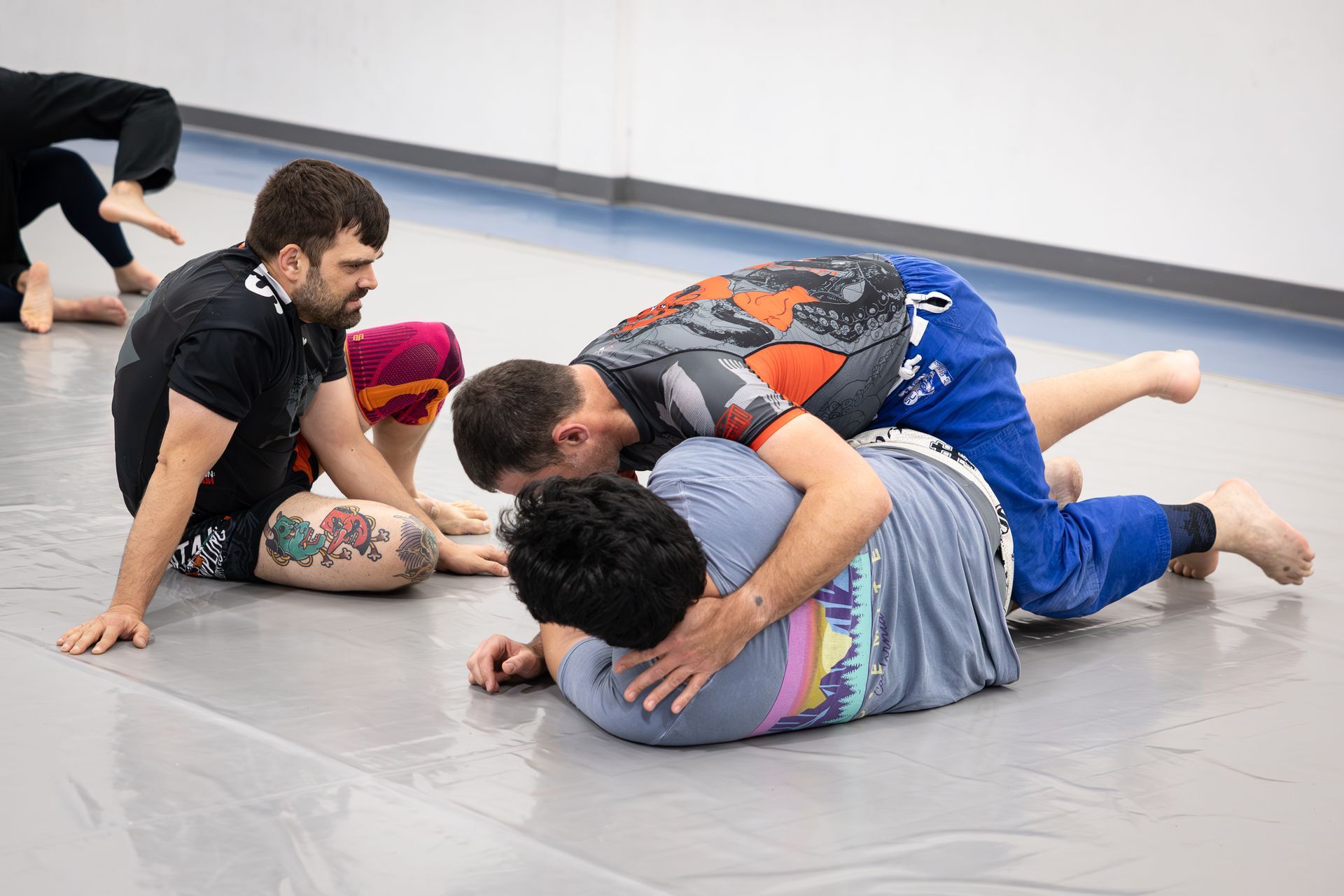
The habits you build in training can sharpen your body, your mind, and your daily decision-making all at once.
Jiu-Jitsu has a funny way of revealing what our routines are really made of. When you’re training consistently, the wins aren’t always dramatic, but you start noticing small upgrades: better composure when you’re tired, clearer thinking under pressure, and a little more patience with yourself (and other people) during the week.
In Hamden, many adults come to the mat for fitness or self-defense, but stay because the structure changes how you show up everywhere else. We see it in how students manage stress, how they problem-solve at work, and how they start treating progress like something you build, not something you wait for.
What follows are the habits we coach every day, the same ones that make Jiu-Jitsu feel less overwhelming and more sustainable, whether you’re brand new or already deep into the journey.
The foundation: show up with a simple plan
There’s a myth that successful training requires intensity all the time. In reality, consistency wins. A steady training rhythm gives your body time to adapt, your mind time to retain patterns, and your confidence time to become real.
When you arrive with a plan, you reduce decision fatigue. You know what you’re practicing, what you’re tracking, and what “good training” looks like today, even if today is not your strongest day.
Train on a schedule you can actually keep
We build progress around repeatable habits, not heroic bursts. If you can train two or three times a week and protect that time like an appointment, you’ll be surprised how quickly Jiu-Jitsu starts to click. Your cardio improves, your timing sharpens, and you spend less mental energy trying to remember what happened last class.
A good schedule also keeps you out of the motivation trap. Motivation is great when it’s there, but routines are what keep you training when life is loud.
Arrive early and “land” before class
Walking in rushed affects everything: attention, breathing, and even how your body moves. We recommend arriving 10 to 15 minutes early when possible. Use that time to change, loosen up, and get your head into training mode.
That tiny buffer has an off-mat benefit too. It reinforces a habit of being prepared instead of reactive, and that carries into meetings, family responsibilities, and stressful commutes.
One skill per session: the habit that prevents overwhelm
Jiu-Jitsu offers endless techniques, and that can be a problem if you try to learn everything at once. The fastest improvement usually comes from narrowing your focus. We like a simple rule: pick one skill to emphasize each session and judge your progress by effort, not perfection.
Pick a “theme” before you slap hands
Your theme can be a position, a concept, or even a single detail. For example:
- Keep your elbows tight in guard
- Win inside position with your frames
- Stand up safely from bottom
- Finish a basic choke with clean mechanics
When you do this, you start noticing opportunities you used to miss. You also build confidence because you’re measuring something concrete, not just asking, “Was I good today?”
Use sparring as a lab, not a test
If sparring feels like an exam, you’ll avoid risks and repeat only what you already know. When sparring becomes a lab, you try new ideas on purpose. Some attempts work, some fail, and both outcomes teach you something.
That mindset is a major bridge between training and real life. You learn to treat mistakes as feedback, which is honestly a superpower in adult life.
Positional rounds: where real progress gets built
Open sparring has value, but positional training is where many adults break through plateaus. Starting in specific scenarios forces you to solve the same problem repeatedly until you can feel the right choices.
If you’re interested in Brazilian Jiu Jitsu in Hamden for practical skill-building, this style of training is a big reason the art works so well. It creates repetition without boredom, and it makes improvements measurable.
Start from the spot that gives you trouble
Most people avoid their weak positions. We encourage the opposite. If side control bottom is tough, start there with clear goals. If you’re getting stuck in closed guard, start in closed guard and practice posture and safe openings.
Progress feels faster when you stop hiding from the hard parts. And yes, it can be humbling, but it’s also straightforward: do the reps, collect the lessons.
Set a micro-goal for each round
A micro-goal keeps you focused even when you’re tired. Examples:
- Recover guard once before the round ends
- Get to an underhook and build to your side
- Keep your base while passing for 30 seconds
- Finish a sweep or stand-up attempt, even if it fails
Those micro-goals build grit in a healthy way. You’re not just surviving, you’re training on purpose.
The training journal: your unfair advantage
A lot of adults assume they’ll remember techniques just because they trained them. Realistically, you’ll remember the feeling of training more than the details, especially as weeks stack up. A journal fixes that.
We recommend keeping it simple: two to five minutes after class. You can use a notebook, your phone, whatever you’ll actually do consistently.
What to write after class
Here’s a clean structure that works without turning this into homework:
- One technique or concept that stood out, written in your own words
- One thing you struggled with and what caused it
- One small win, even if it was just better posture
- One focus for your next class
Over time, you’ll spot patterns. Maybe you always get stuck when you’re flat on your back. Maybe your grip choice is slowing you down. That awareness helps your training become smarter, not just harder.
Why this matters off the mat
Jiu-Jitsu already teaches reflection, but a journal turns it into a repeatable habit. It’s the same skill that improves work performance and relationships: noticing what happened, owning your part, and choosing one thing to improve next time.
Complementary habits that protect your body and extend your career
Adult training is different than training as a teenager. You have work, responsibilities, and joints that need a little more respect than they used to. We care about longevity, because consistency only works if your body can keep showing up.
Strength, mobility, and recovery done the adult way
You don’t need an extreme program. You need a supportive one. Two or three short strength sessions a week and regular mobility work can make your Jiu-Jitsu feel smoother and safer.
Pay extra attention to:
- Neck and upper back mobility for healthier posture
- Hip mobility for guard work and standing balance
- Posterior chain strength for safer bridging and wrestling exchanges
- Grip and forearm conditioning that doesn’t wreck your elbows
And recovery is not a luxury. Sleep, hydration, and walking are boring, but they’re the boring basics that keep you training.
Eat for training, not for punishment
A lot of adults swing between strict dieting and “whatever happens, happens.” We encourage a middle lane. Eat enough protein to recover, enough carbs to train well, and enough overall food that you’re not dragging through class.
When you fuel properly, your decision-making improves too. You’re calmer, less reactive, and more consistent. It’s not magic, it’s physiology.
Communication and community: a habit that accelerates learning
One of the most overlooked habits in Adult Jiu-Jitsu in Hamden is simple communication. If something hurts, say it. If you’re confused, ask. If you need a slower round, communicate that clearly.
We set a culture where training partners help each other improve, because that’s how skill actually spreads through a room.
Ask one question each class
Not ten questions. One. Something specific:
- “Where should my head be in this position?”
- “What grip should I fight first?”
- “What’s the biggest mistake people make here?”
That habit keeps you engaged and makes your progress feel guided, not random.
Be a good training partner on purpose
Technical growth is tied to trust. When you’re safe and controlled, you get more rounds, more reps, and better training partners.
Being a good partner looks like:
- Matching intensity instead of escalating it
- Releasing submissions cleanly and early
- Keeping movement controlled when space is tight
- Helping newer students feel oriented instead of lost
These habits build the kind of confidence that’s quiet and durable. It’s not about proving yourself, it’s about improving.
Mental habits: composure is a trained skill
Jiu-Jitsu trains your nervous system as much as your technique. When you’re pinned, tired, or caught in a tight position, your body wants to panic. We teach you how to stay present and solve the problem in front of you.
That’s one of the biggest benefits for adults with demanding jobs or stressful schedules. You practice calm under pressure multiple times per class, and eventually it becomes familiar.
Breathe, frame, move: your reset sequence
When you feel overwhelmed, return to basics. Slow your breathing. Build frames. Improve your position by inches. This keeps you from making desperate moves that create bigger problems.
It’s also a life skill. When pressure spikes, you don’t need a perfect plan. You need a reset and the next best step.
Redefine what “winning” means in training
If “winning” only means tapping someone, training becomes fragile. Some days you’ll feel sharp, other days you’ll feel like you forgot everything. That’s normal.
We define success as showing up, training with intention, and leaving with one clear lesson. When you do that consistently, your results follow without you chasing them.
Ready to Begin
The best Jiu-Jitsu habit is the one that keeps you coming back with clarity: a manageable schedule, one focus per class, and enough reflection to turn experience into skill. Stack those habits for a few months and you’ll feel the difference in your fitness, your confidence, and how you handle pressure day to day.
If you want a place in Hamden where Adult Jiu-Jitsu in Hamden is taught with structure, safety, and real attention to long-term progress, we built that at Soulcraft Martial Arts, and we’d love to help you get started in a way that fits your life.
Move from reading to rolling to join a Jiu-Jitsu class at Soulcraft Martial Arts today.