
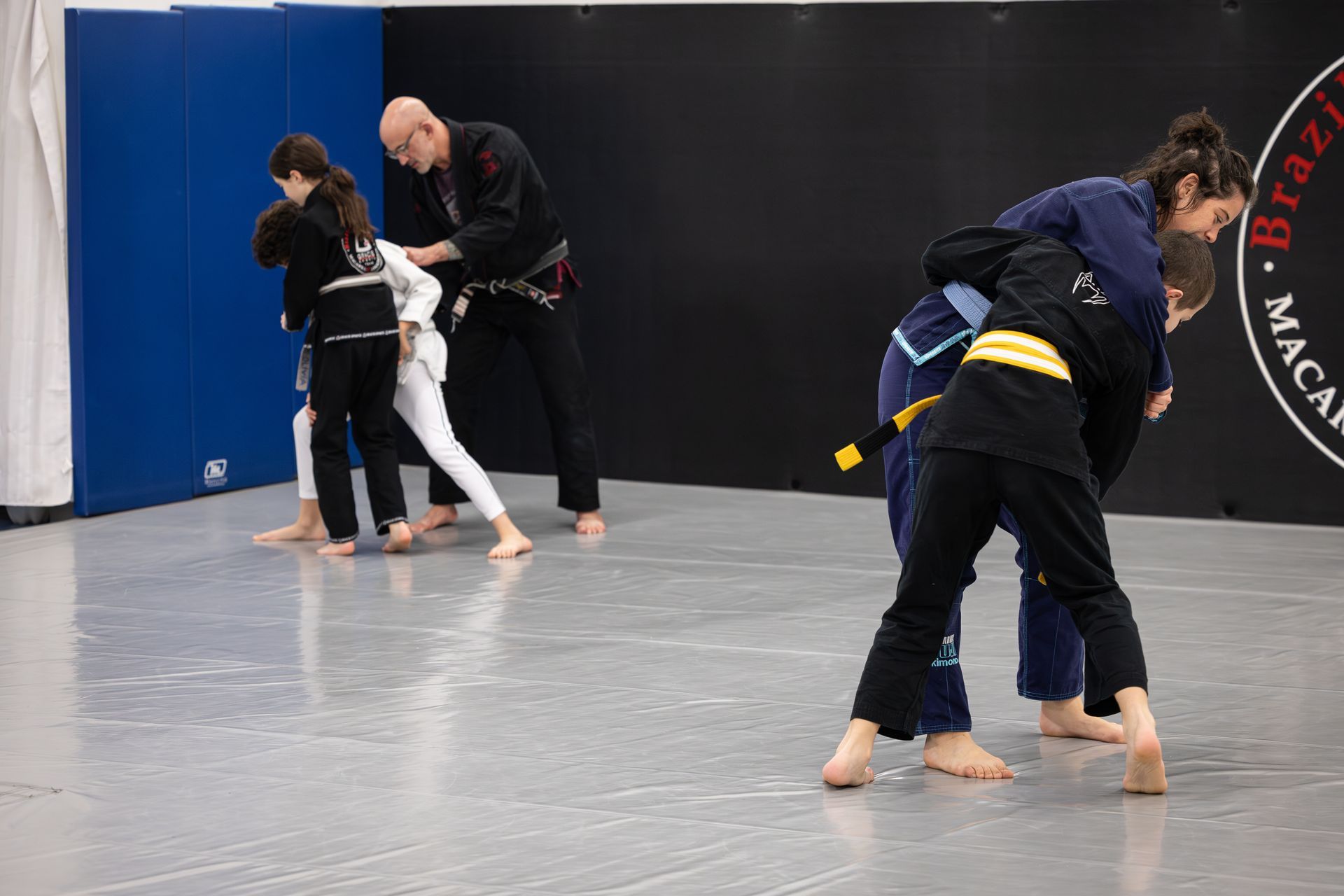
Youth Jiu-Jitsu turns everyday kid energy into coordination, confidence, and calm focus you can actually see at home.
If you are looking for a structured after-school activity that does more than “burn energy,” Youth Jiu-Jitsu is one of the most balanced options we teach in Hamden. It is physical, yes, but it is also deeply skill-based: kids learn how to move their bodies with control, solve problems under pressure, and stay respectful while doing something challenging.
We also hear the same concerns from parents again and again: screen time is creeping up, stress from school is real, and not every sport fits every kid. Our Youth Jiu-Jitsu classes are designed to meet kids where they are and build them up step by step, using age-appropriate coaching, clear structure, and an approach that keeps safety and progress at the center.
What “coordination and balanced growth” really means in Youth Jiu-Jitsu
Coordination is not just “being athletic.” It is timing, balance, spatial awareness, and the ability to make your body do what your brain wants in the moment. In Youth Jiu-Jitsu, we train coordination through repeated movement patterns that show up in almost every class: base, posture, hip movement, controlled grips, and safe ways to get up and down from the ground.
Balanced growth matters, too, because kids do not develop in perfectly even lines. Some children are strong but stiff. Some are flexible but lack body awareness. Some are fast but struggle to slow down and listen. Brazilian Jiu-Jitsu in Hamden can be a great complement to school and other sports because it develops multiple physical qualities together: flexibility, functional strength, endurance, and agility, all anchored by control.
One reason families like grappling for kids is that it is typically lower-impact than striking arts. We focus on positioning, leverage, and movement quality. That helps kids train year-round in Connecticut without feeling like the goal is to take hits. The real goal is to learn how to move well and make good choices while moving.
The physical skills kids build (and why it carries over to daily life)
When parents watch a few classes, the physical training usually looks like a mix of games, drills, and partner practice. Under the surface, there is a lot going on. Youth Jiu-Jitsu teaches kids to stabilize their core while their arms and legs work independently, which is a fancy way of saying: better coordination for everything from running to climbing to sitting still at a desk.
Here are some of the specific physical attributes we build through our training format:
• Balance and base, because kids learn to stay stable while someone is trying to off-balance them in a safe, supervised way
• Hip mobility and flexibility, because so many movements in Jiu-Jitsu come from the hips and trunk, not just the arms
• Functional strength, because kids learn to control their body weight and position instead of just lifting things
• Cardio endurance, because drills and movement-based practice create short bursts of effort with recovery built in
• Body awareness, because kids constantly practice where their hands, knees, and feet are in relation to a partner and the mat
A 2025-oriented review across youth martial arts studies has pointed toward improvements in balance, coordination, agility, and explosive strength, which matches what we see when kids train consistently. The best part is that these gains do not require a child to start “already athletic.” The training itself teaches athleticism in a very practical way.
Confidence without aggression: what kids learn emotionally
Parents often want confidence, but not the kind that comes with acting tough. That is one of the reasons Brazilian Jiu-Jitsu in Hamden has become so popular for youth programs. Because grappling relies on control, leverage, and positional awareness, kids learn that “winning” is not about being wild. It is about being steady.
Youth Jiu-Jitsu is also a training ground for emotional regulation. Kids feel frustration when a technique is hard. Kids feel excitement when they finally hit it. Kids feel nerves when they practice with a new partner. Our job is to coach those moments so a child learns to breathe, reset, and try again, rather than shutting down or spiraling.
Recent parent-facing summaries in the youth BJJ space consistently highlight improvements in self-control, confidence, and problem-solving under pressure. We lean into that by using structured classes, clear expectations, and an environment where respect is not optional. Kids learn to listen, take turns, and handle small setbacks on the mat, which becomes practice for handling bigger feelings off the mat.
A Hamden-friendly solution to screens, stress, and seasonal routines
Hamden is a family-oriented community, and schedules can get busy fast. School, homework, and the long Connecticut winter can make it harder to keep kids moving. Youth Jiu-Jitsu in Hamden works well as an indoor, year-round activity, which is honestly a relief for many families once the weather turns.
We also see how training becomes a routine anchor. Kids who train regularly tend to sleep better, eat a little better, and feel more “settled” in the evenings. Not because Jiu-Jitsu is magic, but because consistent physical activity plus structure does a lot for a developing nervous system.
And for kids who carry school stress, the mat can be a reset. They have a place to focus on one thing at a time. They get clear feedback. They get small wins. That combination matters.
What a beginner Youth Jiu-Jitsu class looks like here
Most kids are nervous the first day, even if they pretend not to be. We keep the process simple and welcoming, and we progress gradually. A beginner class is structured so kids can learn safely while still having fun and moving a lot.
In a typical session, you can expect:
1. A short warm-up that teaches movement skills (not just running in circles)
2. Technique practice in a very controlled format, usually with a clear “start position”
3. Drills that repeat the same movement in a way that builds timing and coordination
4. Supervised partner practice, where we coach posture, spacing, and safety closely
5. Optional, tightly managed sparring or positional games for kids who are ready
That structure is intentional. It helps kids understand what is expected, and it lets us scale the class to different learning styles. The shy child is not forced into chaos. The high-energy child has a place to channel intensity appropriately. And the child who is not “sportsy” gets a skill ladder that makes sense.
Safety and supervision: what parents should know
“Is BJJ safe for kids?” is a fair question. Any sport has risks, but Youth Jiu-Jitsu can be a very controlled environment when it is coached correctly. We manage safety through supervision, rules, and age-appropriate training choices.
Our safety approach is simple: we teach control before intensity. We also build awareness early, like how to fall safely, how to keep a strong posture, and how to communicate with partners. Kids are reminded to respect taps and to stop immediately when instructed. Those habits matter.
We also keep a close eye on pairing. Size, maturity, and experience level all play a role. Beginners are not thrown into advanced rounds. Progression is earned, and we treat that as a positive, not a limitation.
It is also worth noting that structured martial arts training has been associated in some research summaries with reduced aggression and improved prosocial behavior in youth. That matches what parents often want: confidence that comes with restraint, not bravado.
How often should your child train each week?
Consistency beats intensity, especially for kids. Most families start with one to two classes per week, then adjust once the routine feels normal. Youth Jiu-Jitsu is skill learning, so regular exposure helps techniques stick and helps kids feel comfortable in the training environment.
If your child trains sporadically, progress can feel choppy. If your child trains consistently, confidence tends to rise naturally because the environment becomes familiar. The same movements repeat, the same expectations show up, and kids feel themselves improving. That is the kind of progress that builds balanced growth.
When you look at the class schedule, we recommend choosing times that work for your household rhythm, not just the “ideal” training plan. A doable routine is the one that lasts.
Is Youth Jiu-Jitsu right for shy kids, high-energy kids, and beginners?
We designed our youth program to be beginner-friendly and inclusive, because kids show up with all kinds of personalities. Youth Jiu-Jitsu in Hamden is not reserved for a certain “type” of child. In fact, a lot of kids benefit precisely because the class gives them what they are missing.
Shy kids often do well because the structure is predictable. There is a clear start, a clear drill, a clear partner task. Over time, the social side grows naturally. Confidence builds through competence, and that feels more durable than hype.
High-energy kids often do well because we give them a safe outlet and a way to practice control. Instead of “calm down,” the lesson becomes “focus your intensity.” That is a life skill.
Kids who are not athletic often do well because Jiu-Jitsu rewards problem-solving and leverage. When a child learns that technique can overcome size and strength, it can change how they view challenges in general. That shift is big.
Bullying, boundaries, and real confidence
We are careful about how we talk about bullying. There is no single technique that solves social problems. But Youth Jiu-Jitsu can help kids build the components of real confidence: posture, eye contact, calm breathing, and the knowledge that they can manage physical contact if they have to.
We also teach boundaries. Kids learn how to say “stop,” how to ask questions, and how to work with partners respectfully. That social practice matters because it is repeatable. It shows up every class. Over time, kids carry that sense of self into school hallways, playgrounds, and friend groups.
When parents tell us what changed first, it is often not a dramatic self-defense story. It is the small stuff: better listening, fewer meltdowns, more willingness to try hard things, and a little more steadiness in how kids carry themselves.
What to wear and how to prepare for the first class
For your child’s first class, you do not need to overthink it. Comfort and safety are the priorities. If you are not sure what is required, our team can guide you based on the specific session your child will attend.
In general, we recommend:
• Comfortable athletic clothes that allow movement and cover the knees and shoulders reasonably well
• Water bottle and a quick snack for afterward if your child gets hungry after training
• Arriving a little early so your child can settle in, use the restroom, and meet the coach
• A simple mindset: the first class is about learning the room, not being perfect
Kids pick up quickly when the environment is welcoming and structured. After that first class, most of the nerves fade, and you can focus on building a consistent routine.
Take the Next Step
If you want a year-round activity that builds coordination and balanced growth while also teaching calm focus, Youth Jiu-Jitsu is a strong fit for many Hamden families. Our goal is to help your child move better, think more clearly under pressure, and develop confidence that looks like self-control, not chaos.
You can get started with us at Soulcraft Martial Arts by choosing a time on the class schedule that fits your week and coming in for a beginner-friendly session. We keep the process straightforward, and we will help you understand exactly what your child will do in class and how progress works over time.
Ready to put your skills into practice? Start training at Soulcraft Martial Arts.